

Utilities and public agencies are rethinking how the grid stands up to wildfire, and the work is overdue. The grid is unusual among critical systems because it sits on both sides of the problem. It can contribute to an ignition, and once a fire is moving, the network itself is exposed to it.
Wildfire exposure is now a standing line item in infrastructure planning across the western states, and operators face rising scrutiny over the role their equipment plays. Most hardening plans lead with the upgrades that get attention. Far less goes to a layer that is already in the field, already aging, and already combustible. That layer is wood.
The Grid's Wooden Layer Is the Exposed One
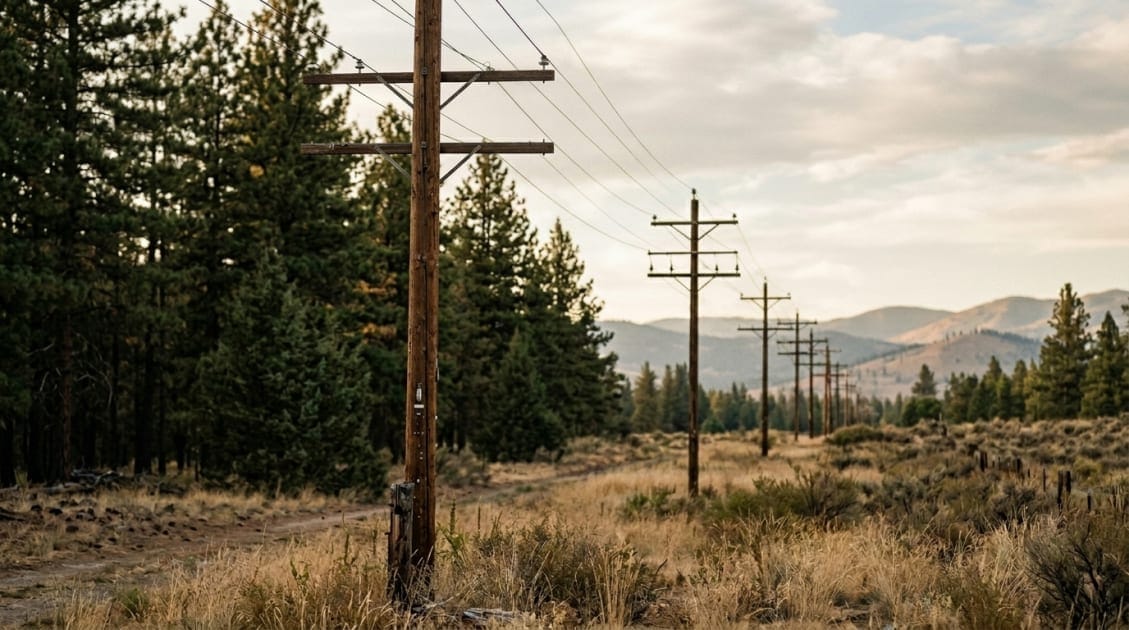
Walk a transmission or distribution corridor and the wood is everywhere. Distribution poles, cross-arms, timber lagging in retaining walls, and the barrier and sound structures that line the right of way. These assets are structural, they sit outdoors, and they stand directly in the path of a fire front.
The physics are unforgiving. Wood begins to pyrolyze and ignite in the range of 250 to 300 degrees Celsius, while a wildfire front can sustain temperatures well above 1,000 degrees Celsius. That gap is the entire problem, and it does not care how new the rest of the grid is.
Scale makes it harder. The installed base of wooden poles and timber structures in the United States runs well into the tens of millions, much of it decades old. Wood stays in service because it is available and economical to install, but that same population becomes the part of the network most likely to carry a fire from one span to the next.
Why Replacement Alone Falls Short
The default hardening menu is replacement. Steel and composite poles, concrete barriers, and undergrounding all have a place, and for new construction they are often the right call.
The trouble is pace and cost. Undergrounding, the most thorough option, is widely estimated to cost several times more per mile than the overhead equivalent, and large programs are scoped across multiple years and budget cycles. Public guidance on grid resilience from the U.S. Department of Energy's Grid Deployment Office frames hardening as a long horizon, not a single season.
While that work proceeds, the existing wood stays energized and in place. A strategy that only counts the assets it can afford to replace leaves the largest and most exposed population untouched for the better part of a decade. The risk does not pause to wait for the capital plan.
What It Takes to Harden Wood That Stays in Place
Protecting wood that remains in the field is a materials question, and it comes down to three things: how the surface behaves under radiant heat, how well a treatment bonds to the substrate, and how it performs across repeated seasons rather than a single exposure.
This is where an engineered coating earns its place. NanoTech's patented Insulative Ceramic Particle technology builds a physical thermal barrier into the film itself. On wood, that barrier rejects radiant heat and slows the transfer that drives a timber asset toward ignition, which buys time when it matters most. Research bodies such as the National Fire Protection Association point to that ignition window as the decisive one for exposed structures.
The performance bar is concrete. Wildfire Shield is rated to 1,800 degrees Celsius, works instantly with no intumescence, and is engineered to hold up without reactivation when the coating system is maintained. Because it bonds directly to the wood, it stays with the asset rather than relying on standoff hardware that can fail at the joint.
A Maintenance Window, Not a Construction Project
The procurement math is where in-place protection separates from replacement. Coating wood already in the ground is a maintenance activity. It can be applied in place or offsite, it adds one crew rather than a sequence of trades, and it is faster and more cost-effective than concrete or cementitious systems.
That changes the calendar. Instead of staging demolition, foundations, and cure time, a district schedules a coating pass during a normal maintenance window and keeps the corridor in service. The same logic that is reshaping recovery work, covered in our note on wildfire recovery as a construction project, applies before any event: protect what is standing, on a schedule you control.
None of this replaces a long-term hardening roadmap. It fills the gap the roadmap leaves open: the wood that will still be standing through several more fire seasons before any replacement program reaches it. Protecting that population is the difference between a plan on paper and resilience in the field this year.
Protect the Wood Already in the Ground
If your hardening plan has a wooden layer, and nearly every plan does, the practical next step is deciding how to protect the assets that will not be replaced soon. See how Wildfire Shield protects timber infrastructure on the Fire Protective Coating System page, or reach our team to walk through a corridor, scope a pilot, or become a Certified Applicator.
Share this article
Ready to Transform Your Building's Performance?
Learn how NanoTech Materials' advanced coating solutions can help you achieve your energy efficiency and sustainability goals.
Get Started