

The way wildfire losses get categorized inside infrastructure groups, insurance carriers, and DOT planning teams has shifted in the last two fire cycles. The old framing was a property claim, sized to a single structure or parcel. The new framing is a community-scale construction project, with permitting, environmental remediation, and recovery construction all running on extended timelines that stretch a year past the fire and often longer.
That reframing is not just a paperwork change. It quietly reorganizes which assets a region needs to protect, when the protection has to happen, and how much of the response can wait until after a loss.
From Property Claims to Community-Scale Rebuilds
When wildfire losses behave like community rebuilds, the work that follows is procurement-heavy. Debris removal. Soil and watershed remediation. Re-permitting on parcels with new code requirements. Rebuilds that compete for the same regional supply of skilled trades and materials at the exact moment those resources are most stretched.
The recovery timelines reflect that. More than a year after major wildfire events, rebuilds are still uneven across neighborhoods. Some parcels are months from permit. Others are well into framing. Others are still waiting on watershed clearance to even begin. The variance itself is the data point.
What does not show up cleanly in a rebuild dataset is the infrastructure that was not destroyed. The wood already in the ground that survived this fire and now has to survive the next one. That is the asset class most at risk of falling between programs.
The Wood That Stays in the Ground Between Fire Seasons
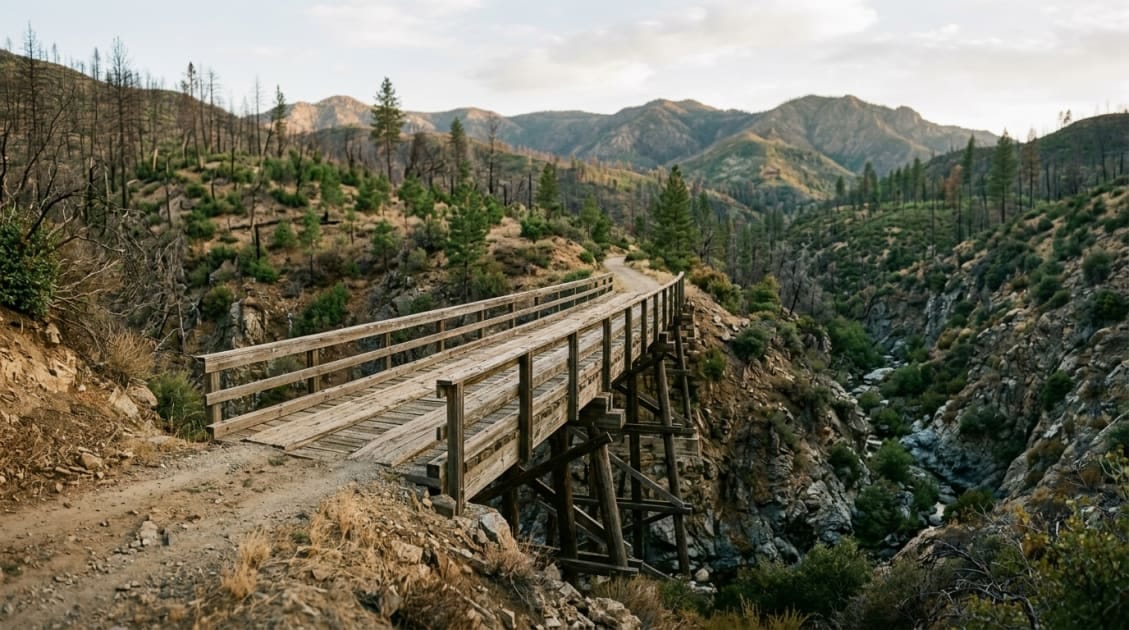
Utility poles still in service from the 1990s. Bridge decks and pile caps on rural and DOT routes. Timber lagging behind highway retaining cuts. Sound walls along corridors. Wooden trestle structures, board and batten siding on outbuildings, treated wood barriers around substation perimeters. The asset list is long, and most of it is not on anyone's near-term replacement schedule.
The reason is operational, not philosophical. Replacing a wooden utility pole takes a crew, a bucket truck, and a service window. Replacing a wooden bridge deck on a state route is a multi-month closure. Replacing the timber lagging behind a half-mile of highway cut is a capital project. None of those projects line up cleanly with the calendar of fire season exposure, which is why this category of asset tends to stay in service much longer than its specified design life.
If wildfire losses now behave like construction projects, the protection-side question changes in the same direction. It stops being whether to replace these assets ahead of fire season. It becomes whether the wood that is going to still be standing on opening day of fire season has any kind of protection layer between it and the next ignition.
Why Concrete Is Not a Like-for-Like Swap
The default infrastructure response to wildfire risk on wooden assets has historically been a material substitution: swap wood for concrete or steel. That works in some cases. It does not work as a portfolio strategy.
A concrete utility pole is a different structural object than a wood pole. It has different load characteristics, different installation requirements, different costs, and different supply chains. A concrete bridge deck replacing a timber deck is a full bridge rebuild, not a deck swap. Sound walls and timber lagging are even harder to substitute because their value is partly the speed and flexibility of wood as a construction material.
Material substitution is a rebuild project. The math works only when the underlying asset was already due for replacement. For everything else, which is most of the wood already in the ground, the practical question is protection, not replacement.
What Asset Protection Actually Looks Like Pre-Season
A protection layer for wooden infrastructure has to do a few things at once. It has to bond directly to wood, across treated and untreated species, without elaborate prep work that would slow deployment. It has to reject radiant heat at the temperatures actually seen in wildfire events, which run far above the rated heat output of a house fire.
Wildfire Shield is built to that performance envelope. The coating bonds directly to wood, rejects radiant heat at 1,800°C, and holds up without reactivation. It is not a fire-suppression product, and it is not a substitute for fuel management. It is an asset-protection layer for the infrastructure that is going to be exposed regardless of how the broader landscape is being managed.
Operationally, that means protection can be deployed during normal maintenance windows. It does not require a full asset replacement, a closure, or a coordinated rebuild. The protection layer is applied to the asset that is already there, before the next ignition window opens.
Where DOT, Utilities, and Insurance Are Aligning
Three professional communities are converging on this protection-layer view at the same time, for related but different reasons. DOT engineers are looking at wooden bridge decks and timber lagging on routes that cannot be rebuilt before next summer, and they are asking what can be done to those structures in the meantime. Infrastructure-resilience program managers at utilities are looking at large wooden pole inventories with replacement windows that stretch over many years. Insurance carriers writing in fire-prone regions are looking at the math of loss frequency versus underwriting exposure on the same wooden assets they have been writing for decades.
All three groups are arriving at a similar place. If the wood is staying in the ground, the protection conversation has to happen at the asset level, between fire seasons, not at the response level after a loss.
That is the conversation worth having before the next fire window opens. Not whether to rebuild. What to do with what is already there.
See how Wildfire Shield protects existing wooden infrastructure.
Looking for deployment in fire-prone regions? Contact Us today.
Background reading: U.S. Fire Administration : Wildland Urban Interface Resources
Share this article
Ready to Transform Your Building's Performance?
Learn how NanoTech Materials' advanced coating solutions can help you achieve your energy efficiency and sustainability goals.
Get Started