

Building codes are usually a lagging indicator. They write down what an industry already learned the hard way. The newest wave of wildfire resiliency codes is different: it’s arriving while the lessons are still fresh, and it’s rewriting how fire performance gets stated, tested, and specified.
For the people responsible for wood infrastructure, the shift matters more than any single product announcement. Here is what’s changing, and what it means for the assets that cannot simply be swapped out.
Code Language Is Catching Up to Fire Behavior
Portions of Colorado's wildfire resiliency code took effect on June 1, 2026, and other fire-exposed jurisdictions are moving along similar paths. The common thread is a change in verbs: materials no longer claim fire performance, they demonstrate it.
That distinction shows up at the submittal stage. Where a product brochure once said fire resistant and a plan reviewer once accepted it, the newer codes ask for a tested rating from a recognized standard. The burden of proof has moved from the buyer to the material.
Specifiers in fire-exposed regions are already feeling the difference. A spec line that cannot point to test data is becoming a spec line that does not survive review.
What a Verified Fire Rating Actually Tells You
The workhorse standard behind many of these ratings is ASTM E84, the surface burning characteristics test. It measures two things: how far flame spreads across a material's surface, and how much smoke the material develops while burning.
A Class A result means a flame spread index of 25 or less and a smoke-developed index of 450 or less. Those are demanding thresholds, and materials that hit them have earned the rating.
There’s a reason specifiers gravitate to these ratings: comparability. Two products tested under the same protocol can be weighed against each other on evidence rather than adjectives, and a plan reviewer can verify the claim in minutes. That’s exactly the function the new resiliency codes are leaning on.
It’s equally important to read what a rating does not say. A surface-burning test describes one exposure under defined laboratory conditions. It does not describe what happens to a material across repeated fire seasons, after years of weathering, or under the sustained radiant heat load of a passing fire front. For infrastructure that lives outdoors for decades, those questions sit outside the certificate.
New Construction Swaps Materials. In-Service Wood Cannot.
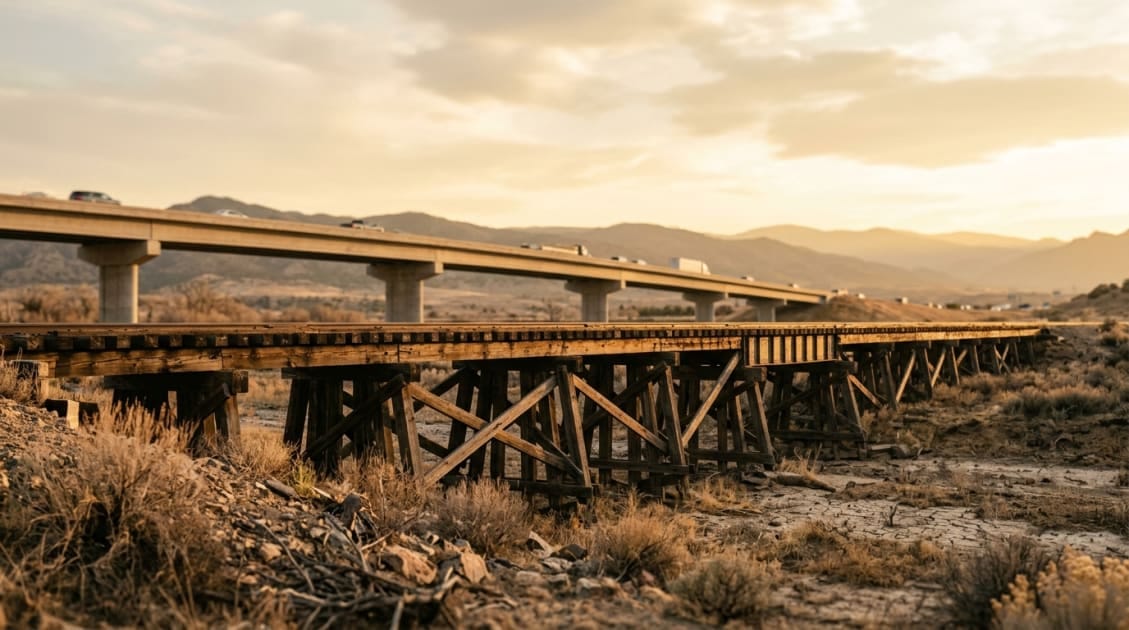
Most code conversations focus on new construction, where a builder can simply select a rated cladding or framing package. The harder problem is the wood that’s already in service: utility poles, timber lagging, bridge members, and highway sound walls.
Common industry estimates put the United States' wooden utility pole inventory around 160 million. Nobody re-sides a bridge, and no utility replaces a pole network because a code changed. Replacement with concrete or steel is a full construction project: design, demolition, lane or corridor closures, forming, and cure schedules.
A protective coating applied to wood in place is a different category of work. It fits inside a maintenance window rather than a capital project calendar, which is why coated-in-place protection is entering so many resiliency conversations.
Four Questions to Ask About Any Fire-Protective System
Once verification becomes the norm, the useful skill is knowing which questions the verification should answer. For systems going onto in-service wood, four matter most.
First, how does it behave under radiant heat? Wildfire attacks infrastructure mostly by radiation ahead of the flame front, so radiant rejection is the property to probe. Second, does it bond to the wood itself? A system that bonds to the substrate leaves no gap for moisture or flame to work behind.
Third, what happens on the second exposure? Intumescent chemistry, for example, activates once by design; the char layer that forms in the first event is spent in forming it. A system that does not depend on an activation step can face repeated events without being rebuilt in between. Fourth, what does it demand between fire seasons? Reapplication cycles and inspection burdens are real costs that belong in the comparison.
Where Coated Wood Fits
This is the territory Wildfire Shield was engineered for. The coating bonds directly to wood, rejects radiant heat without an activation step, and has been rated to 1,800 degrees C in testing, and application in place runs faster and at lower cost than concrete or cementitious alternatives.
For agencies and utilities planning protection work, the practical path is the same one the codes point toward: start from tested performance, then match the system to the asset. Our earlier look at wildfire recovery as a construction project covers the other side of that math: what rebuilding costs when protection waits.
If verified fire performance is entering your specs this year, we’d like to be part of the evaluation. Talk to the NanoTech Materials team about test data, application planning, and our Certified Applicator network.
Share this article
Ready to Transform Your Building's Performance?
Learn how NanoTech Materials' advanced coating solutions can help you achieve your energy efficiency and sustainability goals.
Get Started