

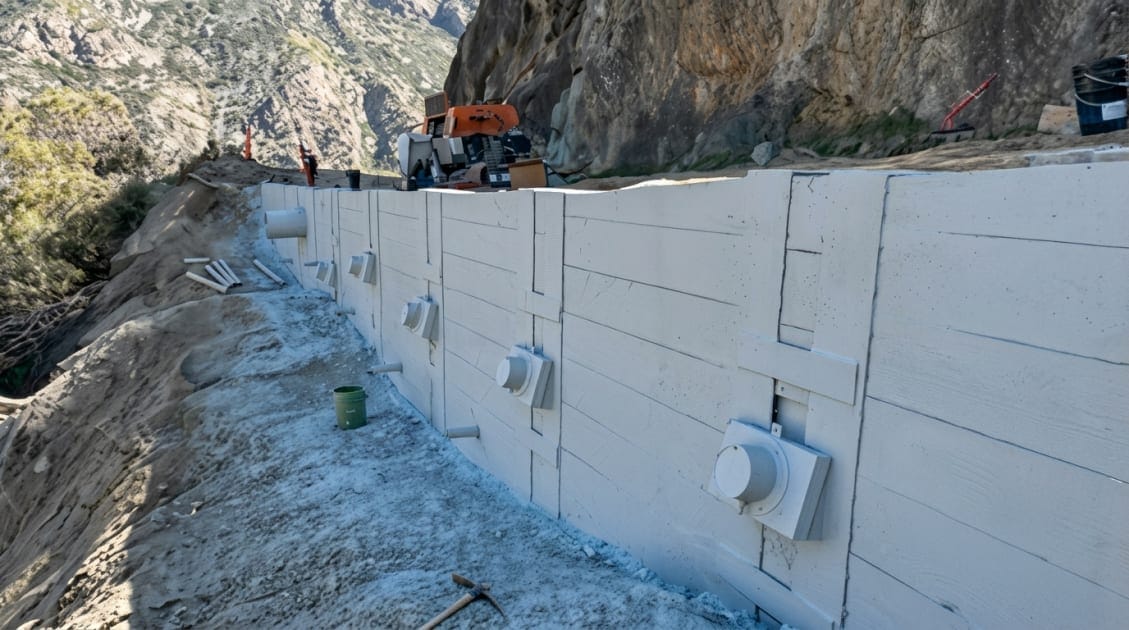
Highway 180 climbs into one of California's most fire-exposed landscapes. To protect a roadside timber-lagging wall there without losing its natural look, NanoTech coated about 600 square feet of it with Wildfire Shield, giving the wood Class A fire protection.
In February 2024, along California's Highway 180 in Sequoia National Park, the Department of Transportation had a 600-square-foot wood timber-lagging wall treated with NanoTech Materials' Wildfire Shield coating. Granite Construction handled the work. The goal was simple: fortify a key roadside structure against the region's growing wildfire risk, and do it without changing the natural character of the setting.
The coating forms a passive, non-sacrificial thermal barrier. It protects the open-air wooden infrastructure and, by extension, the forest it sits in.
Project at a glance
Client | Department of Transportation |
Location | Highway 180, Sequoia National Park, California |
Contractor | Granite Construction |
Product | NanoTech Materials Wildfire Shield |
Scope | ~600 sq ft wood timber-lagging wall |
Application | On-site coating |
Timeframe | February 2024 |
Substrate | Pressure-treated timber lagging |
600 sq ftTimber lagging coated | Class AASTM E84 (0 / 0) | 20 minDirect-flame test |
A national-park road corridor exposed to wildfire
Mountain highways lean on wood timber lagging for their roadside retaining walls. It is economical, easy to install, and it blends into the surroundings. It also burns. Sequoia National Park sits in one of the most fire-exposed landscapes in California, and if a roadside lagging wall ignites, it can lose structural support, close the road, and force a costly emergency rebuild.
The Department of Transportation wanted to cut that risk on Highway 180 without trading the timber for concrete or steel, which would have meant more cost, more disruption, and a structure that no longer fit the park.
Why not replace it with concrete?
Concrete and steel are heavier, slower and more expensive to install, and they clash with the look of a national park. Tearing out sound timber purely over fire concerns is wasteful. The better answer was to keep the wood and protect it.
How wildfire destroys wooden infrastructure, and why the coating matters
In a wildfire, wood fails by igniting and charring under radiant heat and direct flame. Once it burns, it spreads fire and loses load-carrying capacity. Intumescent fireproofing only reacts after the substrate starts to heat. It chars and swells to build a barrier, which means the wood can ignite before the coating activates, and the char itself can give off smoke and toxic gases.
A passive barrier that needs no activation energy
Wildfire Shield works the moment it cures. Its patented Insulative Ceramic Particle technology combines high emissivity, high reflectivity and low thermal conductivity. It radiates absorbed heat, reflects radiant heat, and slows the heat that does reach the wood. The result is a high-temperature thermal barrier with no flame spread and no smoke development (ASTM E84 Class A, 0/0).
In testing witnessed by Department of Transportation personnel, coated timber lagging was held under a direct propane-torch flame for 20 minutes while the thermocouples behind the coating stayed near ambient.
Wildfire Shield applied on-site to the timber lagging
NanoTech-trained applicators with Granite Construction prepared and coated the roughly 600-square-foot wall in place. They cleaned the substrate, checked it for moisture, then built the coating up in passes to the specified dry-film thickness, working it into the geometry of the lagging. The flat white finish blends with the structure.
What the coating system delivered
A Class A coated surface: ASTM E84 Flame Spread 0, Smoke Developed 0
Passive protection that needs no activation energy, unlike intumescent products
Protection built to last across repeated fire events when the system is maintained
The existing timber preserved, with no concrete or steel replacement
A water-based, non-toxic coating suited to a sensitive national-park setting
Backed by NanoTech's 10-year material warranty
Application notes
Wildfire Shield is water-based and goes on by airless spray or roller with common equipment, cleaning up with water. That made it practical to coat the wall in place, with little disruption, in a sensitive location.
Sequoia National Park sits in one of California's most fire-exposed landscapes.
The southern Sierra Nevada has burned repeatedly in recent years, keeping park roads, access routes and the giant-sequoia groves they serve at constant risk.
A hardened structure that still looks the part
The wall came away with Class A passive fire protection and its natural appearance intact, and the work wrapped up with little disruption to the corridor.
Highway 180 was one of the first in a run of Department of Transportation timber-lagging projects across California to use Wildfire Shield. It set the pattern: protect the wood, respect the setting, repeat.
What this means for your team
The same outcome reads differently depending on your role. Here is what this project means for the people who own, specify and apply fire-protection coatings.
For DOT structural & fire-protection engineers
Wildfire Shield gives specifiers a documented, independently tested alternative to defaulting to concrete for fire-exposed wooden infrastructure. It is verified to ASTM E84 (Class A, 0/0), plus E119, E162 and E662, and it came through a 20-minute direct flame-impingement test on timber lagging witnessed by Department of Transportation personnel. That is the kind of evidence it takes to qualify a non-traditional material with confidence.
For DOT district managers & budget authorities
Coating in place, or shop-applying off-site, preserves existing timber lagging instead of replacing it with costlier concrete or steel. Wildfire Shield is non-sacrificial and is built to protect the structure across repeated fire events when the system is maintained, so it stretches mitigation budgets across more lane-miles while keeping crews and traffic moving.
For bridge & highway contractors / applicators
Wildfire Shield is sprayed or rolled with common equipment and conforms to the geometry of timber lagging, abutments and fences, with no jacketing or fabrication required. On-site or off-site shop application removes seasonal and just-in-time bottlenecks, and NanoTech's certified-applicator training and supervision keep DOT-specified work on schedule.
Wildfire Shield technical specifications
Wildfire Shield is a water-based, non-sacrificial fire-mitigation coating built on NanoTech's patented Insulative Ceramic Particle technology. Key published properties are summarized below; confirm project specifics against the current Technical Data Sheet and SDS.
Property | Wildfire Shield |
Product | NanoTech Materials Wildfire Shield (Fire Protective Coating System) |
Coating type | Non-sacrificial, passive fire-mitigation coating; a water-based, flexible elastomeric polymer formulated with NanoTech's patented Insulative Ceramic Particle additive |
How it protects | High emissivity, high reflectivity and low thermal conductivity work together as a high-temperature thermal barrier, resisting flame spread and blocking radiant and conductive heat transfer with no activation energy required (unlike intumescents) |
Fire rating (ASTM E84) | Class A: Flame Spread 0, Smoke Developed 0 |
Tested and validated | Tested to ASTM E84, E119, E162 and E662, and validated by Department of Transportation personnel, including a 20-minute direct propane-torch flame test on coated timber lagging |
Max temperature resistance | Withstands direct flame exposure up to 3,272°F (1,800°C) |
Durability | Holds adhesion and performance through repeated wildfire events; the flexible formula resists cracking, water swelling and abrasion |
Composition and VOCs | Water-based and non-toxic, with no reportable VOCs and no toxic runoff or leaching |
Film build | 20 to 75 wet mils per pass, built to a target 2 mm dry-film thickness (DFT) |
Application methods | Airless spray or roller; pre-applied off-site or applied in the field with common equipment |
Application temperature | 41°F to 120°F |
Surface prep | Power-wash or air-blast to remove debris; no primer required in most cases |
Moisture and cure | Apply when surface humidity is below 19%; allow at least 48 hours before exposure to rain or freezing |
Maintenance | Annual inspections recommended; touch up by overcoating, and clean with soapy water or a low-pressure wash |
Storage and shelf life | Store between 41°F and 100°F and avoid freezing; 12-month shelf life |
Substrate compatibility | Timber lagging and other Department of Transportation-approved substrates |
Quality and warranty | Manufactured under an ISO 9001:2015 quality framework; 10-year material warranty (terms apply) |
Frequently asked questions
Does the coating change how the timber lagging looks?
Not really. Wildfire Shield goes on as a thin flat film, standard white with custom colors available, and it follows the shape of the wood. The structure keeps its form, so the wall blends into a sensitive setting like a national park.
Can it be applied without major road closures?
Yes. It is applied in place with standard spray or roller equipment and cleans up with water, so the work moves with minimal disruption, using one-way traffic control only where needed.
How is Wildfire Shield different from intumescent fireproofing?
Intumescent coatings have to be triggered by fire. They char and swell only after the substrate begins to heat, so the wood can ignite before the coating activates, and the char can give off smoke and toxicity. Wildfire Shield is non-sacrificial and works the moment it is applied. Its mix of high emissivity, high reflectivity and low thermal conductivity reflects and re-radiates heat and slows the heat that reaches the wood, with no flame spread and no smoke development (ASTM E84 Class A, 0/0).
Can the coating survive more than one fire?
Yes. Because it is non-sacrificial, Wildfire Shield is designed to protect the underlying structure through repeated wildfire events when the coating system is inspected and maintained. NanoTech recommends yearly inspections for wear, cracking or damage, and worn areas can be touched up by overcoating rather than fully replaced.
How hot can Wildfire Shield withstand?
It withstands direct flame exposure up to 3,272°F (1,800°C). In testing witnessed by Department of Transportation personnel, coated timber lagging was held under a direct propane-torch flame for 20 minutes while the thermocouples behind the coating stayed near ambient.
Is it safe and environmentally responsible?
Wildfire Shield is water-based and non-toxic, with no reportable VOCs and no toxic runoff or leaching, and it is not classified as hazardous for supply or use. It cleans up with water and suits sensitive settings such as national parks and the wildland-urban interface.
Related resources
From NanoTech Materials
External references
Talk to NanoTech about wildfire protection
Protecting timber lagging, bridges, utility poles, fences or homes in a wildfire-prone area? Talk to NanoTech about Wildfire Shield, or join our certified-applicator network. Call (888) 296-6266, email [email protected], or visit our contact page.
About NanoTech Materials. NanoTech Materials is a Houston-based materials-science company developing advanced coatings for energy efficiency and fire protection. Its Fire Protective Coating System, including Wildfire Shield, is built on patented Insulative Ceramic Particle technology to protect critical wooden infrastructure and high-value assets from wildfire, buying time and saving lives.
© 2026 NanoTech Materials. All rights reserved. Performance data summarized from NanoTech technical documentation (TDS, SDS, Application & Technical Manual) and the Wildfire Shield Project Portfolio; confirm project-specific details and current published values with a NanoTech representative.
Share this article
Ready to Transform Your Building's Performance?
Learn how NanoTech Materials' advanced coating solutions can help you achieve your energy efficiency and sustainability goals.
Get Started