

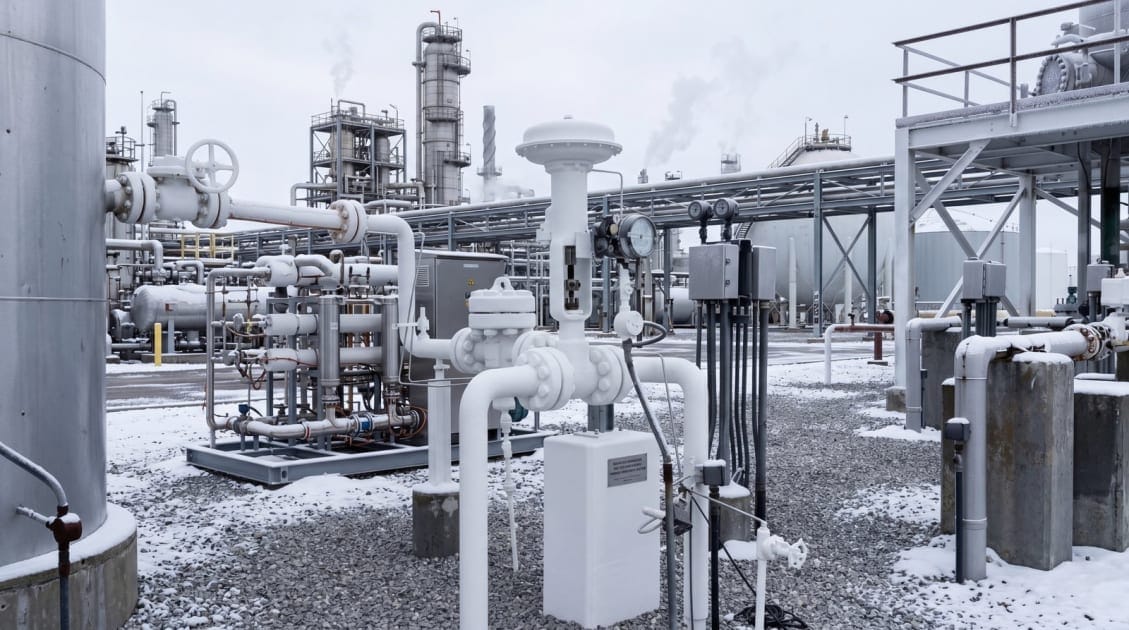
A thin-film NanoTech Cool Touch coating replaced bulky workarounds and reduced reliance on heat tracing, eliminating recurring ice and condensation on outdoor gas equipment across three consecutive Michigan winters.
IN SHORT
A natural gas operator in Michigan kept battling ice and condensation on outdoor flow meters and valves each winter, even with covers and heat tracing. NanoTech applied a 5 mm Cool Touch insulating coating directly to the equipment. The coating reduced heat flux and stabilized surface temperatures, eliminating major ice accumulation and keeping valves and meters running through three consecutive winters.
PROJECT AT A GLANCE
LOCATION Michigan, USA | INDUSTRY Natural gas / oil & gas infrastructure |
ASSETS TREATED Flow meters, valves & piping | ENVIRONMENT Outdoor winter: snow, humidity, freeze cycling |
PRODUCT NanoTech Insulative Coat: Cool Touch | APPLIED BUILD 5 mm, multi-pass thin film |
CHALLENGE Recurring icing, condensation & CUI risk | OUTCOME Ice eliminated; 3 winters of stable operation |
THE CHALLENGE
Recurring icing and condensation on cold gas equipment
The customer faced repeated icing and condensation on natural gas flow meters and valves every winter. Even with protective covers and, in places, electric heat tracing, moisture kept accumulating and freezing around critical components, fouling instrumentation and disrupting operation.
Northern Michigan makes this a hard problem. The operator sits in a lake-effect snowbelt where January lows average in the mid-teens (°F) and seasonal snowfall is heavy. The area recorded roughly 186 inches in the 2024–25 winter. Cold, humid air and blowing snow are in near-constant contact with metal surfaces that are already cold from the gas inside them.
Observed issues before treatment
Ice buildup on valves and instrumentation
Flow instability caused by localized freezing
Operational interruptions during winter conditions
Maintenance concerns tied to moisture and thermal cycling
Ongoing risk of corrosion under insulation (CUI)
Fundamentally, this is the same thermodynamic mechanism seen in chilled-water piping and cryogenic anti-condensation work: a cold surface meeting humid ambient air. Covers and heat tracing treat the symptoms and add energy cost and maintenance, but they don't change the surface-temperature behavior that drives the icing in the first place.
THE SCIENCE
Why cold gas equipment ices up in winter
Ice forms on the outside of gas equipment when the metal surface drops below the dew point of the surrounding air. Humid air contacting that cold surface condenses, and below 32 °F (0 °C) the condensate freezes. The colder the metal is relative to the air, the faster moisture collects and freezes.
The Joule–Thomson effect chills the metal
Natural gas systems reduce pressure at regulating and metering points. As the gas expands across a regulator or valve, it cools, the Joule–Thomson effect. As a rule of thumb, a 100-psi pressure drop produces roughly a 6–8 °F temperature drop in the gas. That cold gas chills the valve bodies, meter runs, and piping from the inside, pulling their outer metal surfaces well below ambient temperature.
Below the dew point, moisture condenses, then freezes
Once a metal surface sits below the dew point, water vapor in the surrounding air condenses onto it. In a Michigan winter, that surface is also below freezing, so the condensate turns to ice and accretes layer by layer on valves, linkages, and instrument ports. The same persistent surface wetness drives corrosion, and where covers or insulation trap that moisture against the metal, it accelerates corrosion under insulation (CUI).
Why covers and heat tracing fall short
Protective covers and electric heat tracing fight the cold rather than the heat transfer that causes it. Heat tracing adds continuous energy draw, wiring, and points of failure; covers can trap moisture. Neither raises the equipment's exterior surface temperature in a stable, passive way — so as soon as conditions turn, the condensation and icing return.
THE NANOTECH SOLUTION
A thin-film thermal barrier applied directly to the equipment
NanoTech applied a 5 mm build of Cool Touch insulating coating directly to the affected valves, meters, and piping. Cool Touch is a water-based coating built on NanoTech's patented Insulative Ceramic Particle technology, engineered for very low thermal conductivity and high surface emissivity. It adds thermal resistance as a seamless, adhered film instead of a bulky jacketed system.
How it suppresses condensation and ice
The coating decouples the outer surface from the cold metal beneath it. By reducing heat flux through the substrate and stabilizing the temperature across the metal, Cool Touch keeps the exterior coated surface much closer to ambient air temperature, above the dew point under most operating conditions. With the surface no longer running below the dew point, condensation has little chance to form, and ice can't accrete.
It is the same physics NanoTech uses on hot service, running in the opposite direction: a thermal barrier reduces heat flux either way. On a hot pipe it keeps the touchable surface cool; on cold gas equipment it keeps the surface warm relative to the chilled substrate.
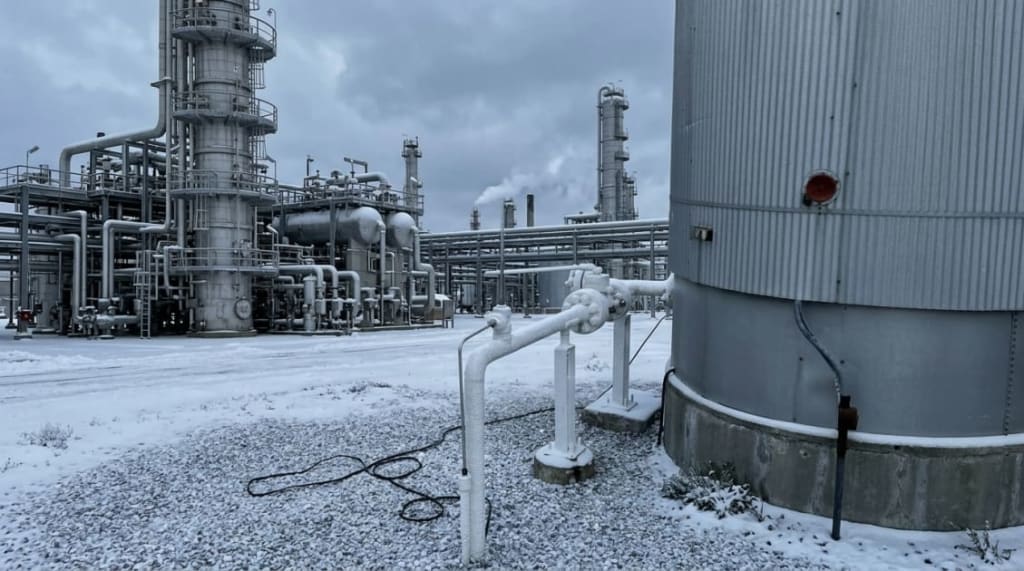
What the coating system delivered
Low thermal conductivity to slow rapid heat transfer through the metal
Temperature stabilization across the metal surface
Reduced surface-temperature differentials that drive condensation and icing
Thin-film protection without bulky traditional insulation systems
A seamless, adhered barrier that does not trap moisture against the substrate, so it does not promote CUI
Practical application notes
Cool Touch is applied by airless spray, hopper, roller, or brush, conforming to the complex geometry of valves, fittings, and instrument runs that are difficult to wrap with conventional insulation. Because it goes on as a thin film and cures in place, the equipment keeps its serviceable profile — gauges, linkages, and bolting stay accessible for inspection. The coating remains flexible through thermal cycling and resists UV, cracking, and abrasion in outdoor service.
ENGINEERING NOTE
Cold gas inside + snow outside creates the same condensation and icing dynamics observed in chilled-water systems. NanoTech's thin-film thermal barrier reduces heat flux and stabilizes surface temperatures to suppress freeze formation.
THE RESULTS
Three winters of stable, ice-free operation
Across three consecutive winters of field service, the treated equipment stayed clear of the major ice accumulation that had disrupted it before. Valves and flow meters operated reliably through snow and freezing conditions, and the site reduced its dependence on heat tracing.
✔ Over three consecutive winters of successful field performance
✔ Elimination of major ice accumulation issues
✔ Stable operation of valves and flow meters during snow and freezing conditions
✔ Reduced dependence on heat-tracing systems
✔ Improved reliability in harsh outdoor winter environments
✔ Protection against moisture-related corrosion mechanisms
Before vs. after: observed field behavior
Condition | Before | After Cool Touch |
Ice on valves & instrumentation | Recurring buildup each winter | Major accumulation eliminated |
Flow stability | Instability from localized freezing | Stable through snow & freeze |
Winter operation | Periodic interruptions | Reliable across 3 winters |
Heat tracing | Relied upon, limited effect | Reduced dependence |
Corrosion / CUI risk | Ongoing from trapped moisture | Reduced — no moisture trapped |
WHAT THIS MEANS FOR YOUR OPERATION
Relevance across the project team
For asset owners & plant managers
Fewer winter interruptions and less reliance on heat tracing mean lower operating costs and risk. A thin film that doesn't trap moisture also reduces the CUI exposure that drives unplanned maintenance on cold and ambient service.
For EPC firms & specifiers
Cool Touch is a sprayable, single-product thermal barrier with documented standards testing (NACE TM21423, ISO 12944, ISO 9227). It simplifies cold-service anti-condensation details on complex geometry where wrapping insulation is impractical.
For coating contractors
Spray, roll, or brush application with common equipment, no jacketing or fabrication. The coating conforms to valves and fittings quickly, opening anti-condensation and freeze-protection scopes that traditional insulation makes slow and labor-heavy.
PRODUCT REFERENCE
Cool Touch technical specifications
Cool Touch (Insulative Coat) is a water-based, high-solids thermal barrier coating built on NanoTech's patented Insulative Ceramic Particle technology. Key published properties are summarized below; confirm project specifics against the current Technical Data Sheet.
Core technology | Patented Insulative Ceramic Particle; low thermal conductivity, high emissivity |
Chemistry | Water-based, 75% solids by volume, non-reportable VOC |
Function | Thermal barrier, safe-touch surface control, condensation & moisture-ingress control |
Dry heat resistance | 302 °F (150 °C) (ASTM D2794) |
Min application temp | 40 °F (4 °C) minimum |
Dry film thickness | 40–200 mils (1–5 mm) DFT per spec; built up in multiple passes for cold-service / anti-condensation duty |
Application methods | Airless sprayer, hopper, roller, or brush |
Durability | Elastic and flexible through thermal cycling; no blistering, cracking, or flaking in salt-spray and condensation testing; humid and salt-spray suitable |
CUI behavior | Seamless adhered film; does not promote corrosion under insulation |
Standards tested | NACE TM21423; ISO 9227:2017 (salt spray); ISO 12944-6:2018; ISO 6270-1:2017 (condensation); ASTM D2794 (dry heat) |
FAQ
Frequently asked questions
How does an insulating coating stop ice from forming on gas valves and meters?
Ice forms when a metal surface drops below the dew point of the surrounding air and below freezing. A thin-film insulating coating like Cool Touch adds thermal resistance between the cold gas equipment and the outer surface, reducing heat flux and stabilizing the surface temperature closer to ambient. Keeping the exterior surface above the dew point under most conditions suppresses condensation, so ice has nothing to build on.
Why do natural gas meters and valves ice up in winter in the first place?
Two effects combine. Gas expanding across regulators and valves cools through the Joule–Thomson effect, roughly 6–8 °F per 100 psi of pressure drop, chilling the metal from the inside. Outside, cold humid air and snow contact that chilled metal. When the surface sits below the dew point and below 32 °F, moisture condenses and freezes on valves and instrumentation.
Can a coating replace electric heat tracing on gas equipment?
In this Michigan project, the coating reduced dependence on heat tracing rather than removing every trace circuit. By passively stabilizing surface temperatures, Cool Touch addresses the heat-transfer behavior that causes icing, which lowers the load on — and reliance on — active heating. Whether tracing can be eliminated entirely depends on the specific service, gas temperatures, and pressure drops involved.
Does the coating cause corrosion under insulation (CUI)?
No. Cool Touch is applied as a seamless, adhered film rather than a wrapped or jacketed system, so it does not create the gaps where water collects against the metal. NanoTech reports it does not promote CUI and is suitable for humid and salt-spray environments, which is a key advantage over traditional insulation that can trap moisture.
How thick is the coating, and how is it applied?
For this freeze-protection application a 5 mm build was applied directly to the valves, meters, and piping in multiple passes. Cool Touch goes on by airless spray, hopper, roller, or brush and conforms to complex valve and fitting geometry. It cures in place as a thin film, so instruments and bolting stay accessible for inspection.
What is Cool Touch and how does it work?
Cool Touch is NanoTech Materials' water-based Insulative Coat, built on patented Insulative Ceramic Particle technology. It combines very low thermal conductivity with high emissivity to act as a thin-film thermal barrier. On hot equipment it lowers touchable surface temperature for burn protection; on cold equipment it keeps the surface warm relative to the chilled substrate to suppress condensation and ice.
Is the result from this Michigan project repeatable in other cold climates?
The mechanism is general. Anywhere humid air meets sub-dew-point metal (northern winters, chilled-water lines, cryogenic and refrigerated service), the same heat-flux and surface-temperature physics apply. Results in any given installation depend on gas conditions, geometry, ambient climate, and the specified coating build, which NanoTech reviews per project.
TALK TO NANOTECH
Have cold-service icing or condensation to solve? Contact NanoTech about freeze-protection and anti-condensation coating for valves, meters, and piping — or join our certified applicator network at nanotechmaterials.com/contact-us.
About NanoTech Materials
NanoTech Materials is a Houston-based materials science company developing advanced coatings for energy efficiency and safety. Its Insulative Coating System, including Cool Touch, uses patented Insulative Ceramic Particle technology to provide thin-film thermal protection for oil & gas, chemical, power, and marine equipment.
Disclaimer: Performance described reflects a specific field application in Michigan. Results depend on service conditions, surface preparation, applied film build, and ambient climate, and may vary by installation. Confirm product suitability and specifications against the current NanoTech Cool Touch Technical Data Sheet and Safety Data Sheet. Standards are referenced for the product's published testing; this case study is not a certification of any specific installation.
Share this article
Ready to Transform Your Building's Performance?
Learn how NanoTech Materials' advanced coating solutions can help you achieve your energy efficiency and sustainability goals.
Get Started