

Two quotes land on a facility manager's desk and they never look comparable. One restores the roof. One replaces it. The number at the bottom of the replacement quote is larger, and that is where most of the conversation goes.
It is the wrong first question. Before price enters the room, a roof either qualifies for a restoration coating or it does not, and that is a condition call rather than an age call. A twenty-year-old membrane in fair shape can be an excellent candidate. A twelve-year-old membrane that has already failed is not at any price.
Restoration is drawing more interest right now for reasons that have nothing to do with coatings. Reroofing costs have climbed, crew availability is tight, and building owners are under pressure to keep existing assets in service rather than send them to a landfill. A fluid-applied system asks less of a crew than a tear-off does, which matters when staffing is the constraint. None of that changes the qualification question. It just makes more people ask it.
What disqualifies a roof
A coating works in conjunction with an existing roofing system. It is a layer added to something that still functions, not a repair for something that has stopped functioning. The distinction is not marketing hygiene; it is the difference between a system that performs for years and a callback.
The disqualifiers are usually structural or moisture related rather than cosmetic. Saturated insulation under the membrane is the most common one, because a coating seals moisture in rather than letting the assembly dry. Deck deterioration is another. So is widespread seam separation that has moved past the point where repair is economical, and so is any active leak that has not been isolated and fixed first.
A chalked, dirty, sun-beaten membrane that is still watertight and sitting on dry insulation is a different situation entirely. That roof is a candidate, and it is the population most restoration programs are aimed at.
This is why an honest applicator inspects before proposing. If the assessment happens after the proposal, the proposal was a guess.
What condition assessments should include
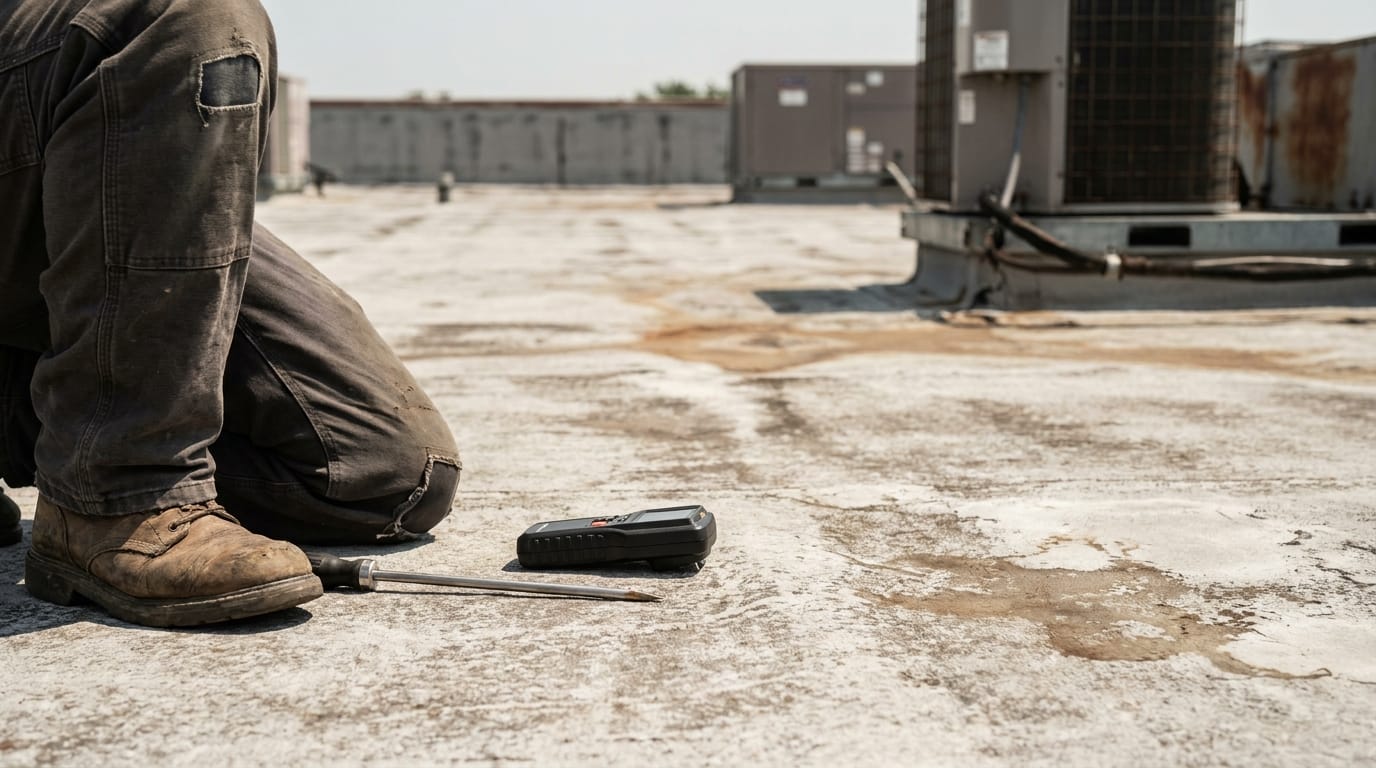
A useful assessment produces evidence, not an opinion. At minimum it should cover moisture in the assembly, measured with an infrared scan or a capacitance meter rather than inferred from the surface; seam and flashing condition at penetrations, curbs and the perimeter, since that is where most water enters; drainage behavior and where water stands after rain; deck and fastener condition; and substrate identification, because compatibility is not universal.
Cool Roof Coat bonds to TPO, EPDM, PVC, metal, built-up roofing, modified bitumen and spray polyurethane foam. Substrate identification still belongs in the assessment, because prep requirements differ even where compatibility does not.
Ask for the findings in writing. A restoration decision that cannot be reconstructed six months later is not a decision; it is a preference.
Pricing a coating against replacement, properly
Once a roof qualifies, the comparison worth running is the coating priced against replacement, and it has three columns rather than one.
Material and labor is the column everyone builds. Schedule is the one that gets underweighted: a tear-off means open deck, weather exposure and a sequence that cannot easily pause, while a fluid-applied restoration is typically measured in days and the building stays operational throughout. Disruption is the third column, and on a distribution center, a hospital wing or a school inside a tight occupancy window it is frequently the column that decides.
Put the number in the room, then put the schedule and the disruption next to it. That comparison is worth pricing on its own terms. What it is not is a reason to skip the assessment, because a coating on a roof that did not qualify is the most expensive option on the page.
What the coating is doing once it is down
Here the language matters, because two words get used interchangeably and mean different things. Heat reflection sends radiation back off the surface. Heat rejection describes a barrier distributed through the film itself rather than sitting on top of it.
That distinction has a practical consequence on a roof nobody visits. A surface-dependent mechanism degrades as the surface collects dirt, biological growth and airborne grease, which every commercial roof does. A barrier distributed through the film has less riding on surface condition, so the result is less sensitive to how clean the roof is in year three.
Cool Roof Coat is built on NanoTech's patented Insulative Ceramic Particle technology, engineered hollow ceramic structures that scatter heat and slow thermal transfer at the particle level. On the performance side, the figures worth asking any manufacturer for are the ones attached to a rating body or a test method. Aged solar reflectance and Solar Reflectance Index are rated by the Cool Roof Rating Council, and aged is the number to ask for, since initial values flatter every product in the category. Cool Roof Coat is also Title 24 compliant, ICC-ES evaluated, Miami-Dade certified and produced under ISO-9001.
If a supplier quotes you a performance figure and cannot name the method or the body behind it in the same sentence, treat the figure as marketing rather than data. That applies to us as much as to anyone else.
The sequence, in order
Assess first and get the findings in writing. Fix active leaks and replace wet insulation before anything is coated. Confirm the substrate and the prep it needs. Then price the coating against replacement across material and labor, schedule and disruption, and make the call with all three columns visible.
Roofs that qualify tend to reward restoration. Roofs that do not tend to punish it. Almost everything else in this decision follows from knowing which one you have.
Next step
If you want a condition assessment on a specific building, or you want to compare a restoration against a replacement quote you already hold, our team can walk the roof and put the findings in writing. Start at the Cool Roof Coat restoration page.
Share this article
Ready to Transform Your Building's Performance?
Learn how NanoTech Materials' advanced coating solutions can help you achieve your energy efficiency and sustainability goals.
Get Started