

Editor's note: Cool Touch is now NanoTech Insulator, part of NanoTech's Insulative Coating System. This article is shown as originally published.
Most insulating coating decisions on hot process equipment get made on two questions. Will the surface come down to a compliant touch temperature, and can we apply it without taking the unit down. Both are reasonable. Both are answerable from a data sheet in about ninety seconds. And together they miss the criterion that decides the cost over a twenty-year service life, which is what the steel is doing underneath the coating you just specified.
Here is the full evaluation, in the order that matters.
Criterion one: touch temperature across the whole service band
The first question most reliability engineers ask about an insulating coating for pipes is whether it brings the outside surface into a compliant range for personnel contact. That is the right first question. Hot exterior surfaces on process piping, valves and steam headers are a recurring audit finding, and OSHA and NACE reference temperatures are what the finding gets written against.
The word that gets skipped is "across." A coating that lands on a compliant surface temperature at the design point will not necessarily hold it at the top of the operating band, through a startup ramp, or on a line that swings between batches. A single headline number describes one operating condition, and your unit does not run at one operating condition.
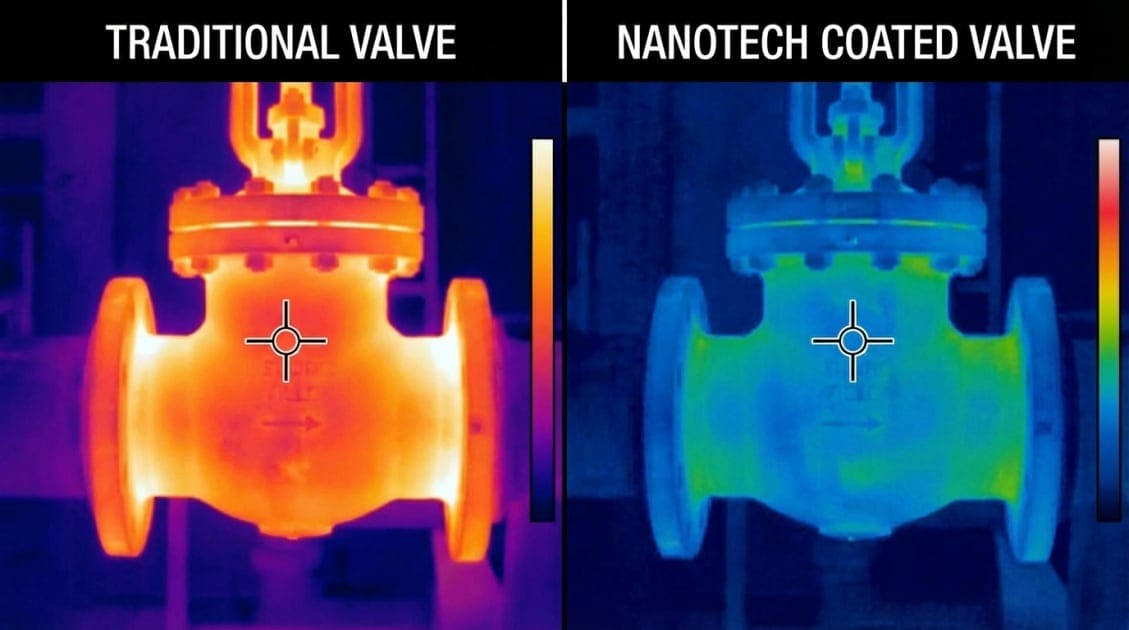
Ask for performance across the full service range. Insulative Coat: Cool Touch is rated across the 150°F to 350°F service band, the band most insulated process piping actually lives in, with the rating validated by NACE/AMPP TM21423 touch-temperature testing, and it stabilizes surface temperature in both directions, hot and cold. That second half matters more than it sounds, because the same asset that runs hot in August runs cold and wet during a shutdown.
Criterion two: what the work costs you in downtime
The second question is scheduling, and it is usually asked as a budget question when it is really a calendar question. A traditional jacketed system means scaffolding, removal, cut-and-fit, and re-jacketing. On live equipment that generally means waiting for the turnaround window, which means the exposure you identified in March sits open until the next outage.
The number to ask for is the surface temperature at which the coating can be applied. Cool Touch goes onto live equipment at surface temperatures up to 200°F, in 1 to 2 coats, applied directly to the substrate. It conforms to complex geometry, so valves, flanges, elbows and nozzles get the same treatment as straight run instead of a cut-and-fit approximation of one. It also carries no reportable volatile organic compounds (VOC), which removes one of the usual reasons a coating job gets pushed to an outage.
Getting the work off the turnaround critical path is not a convenience. It is the difference between closing an exposure this quarter and carrying it for another eighteen months.
Criterion three: what the steel is doing under the film
This is the criterion that decides the twenty-year number, and it is the one that almost never appears in the evaluation matrix.
Corrosion under insulation is not an insulation performance problem. It is a geometry problem. A jacketed or wrapped system introduces three features a bare pipe does not have: a seam at every termination and every nozzle, a fibrous mass that holds water rather than shedding it, and an annular gap between the insulation and the steel. Water arrives through seam failures, weather, washdown, or condensation forming during a shutdown. Then it stays in contact with the steel, out of sight.
The 150°F to 350°F band is the worst of it. Hot enough that the line gets insulated, cyclic enough that condensation forms on shutdown and startup, and not hot enough to keep the substrate consistently dry. Coastal and washdown environments compress the timeline further.
The expensive part is not the corrosion. It is that the jacketing conceals it. Wall loss gets found when insulation comes off for a turnaround, or after a leak, by which point the finding is a repair rather than a plan.
A bonded thin film changes the geometry rather than managing it. Cool Touch adheres to the substrate instead of wrapping around it, so there is no jacket seam, no fibrous mass and no annular gap for water to collect against the steel. The surface stays visible during a routine walk-down, which turns condition monitoring from a scaffolding project back into a line-of-sight check.
The test record behind that: 720 hours of neutral salt spray exposure to ISO 9227 with no blistering, cracking or flaking. Cool Touch also conforms to NACE TM21423 and to ISO 12944 for corrosion protection in industrial and marine atmospheres.
How to write the three criteria into a spec
Put them in order and ask for evidence against each one rather than a claim against each one.
Touch temperature, stated across the full service band with the operating range named, not at a single design point. Application conditions, stated as a maximum substrate temperature and a coat count, because those two numbers set your schedule. And substrate condition, stated as a description of what holds water against the steel in the proposed system and how a technician verifies the condition of that steel without removing anything.
Then ask for the paperwork. A technical data sheet, an SDS, a technical manual, and third-party test reports against named standards. A supplier who can hand you all four without a follow-up call has already answered most of the third criterion.
Where this changes the number
Two coatings can produce the same touch temperature on the same line and carry completely different lifecycle costs, because one of them requires a demolition-and-reinsulate cycle the other does not, and because one of them hides the substrate while the other leaves it visible. Neither of those shows up in a touch temperature comparison. Both of them show up in a maintenance budget.
If you are scoping insulated piping, tanks or vessels for the next turnaround cycle, the third criterion is the one worth asking first.
Share this article
Ready to Transform Your Building's Performance?
Learn how NanoTech Materials' advanced coating solutions can help you achieve your energy efficiency and sustainability goals.
Get Started