

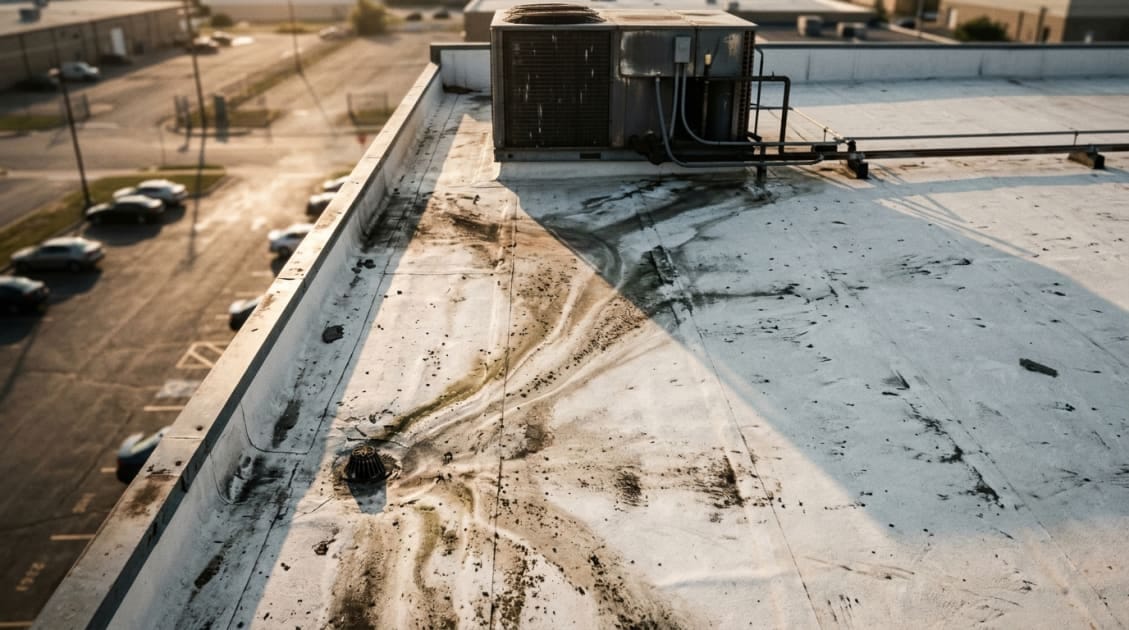
The cool-roof category had another headline week. A new round of reflective-paint research is back in the news cycle, with lab figures in the 90%-plus solar reflectance range and adjacent claims about passive water harvesting. The visual is striking. The number behind the number is what matters once a building has been in service for five summers.
Reflectance is a surface property. It is what a fresh coating bounces back on day one, under controlled lab conditions. Heat rejection is a through-thickness property of the coating itself, and it is the variable that determines what conducts through to the deck below in year five. They are not the same number, and they do not decay at the same rate.
For facility teams writing roof specs, the distinction has direct consequences for HVAC sizing, asset life, and utility budgets.
What Reflectance Measures, and What It Does Not
Solar reflectance is the fraction of incident solar radiation that a roof bounces back into the atmosphere. The Cool Roof Rating Council (CRRC) tests and lists this number under standardized conditions, both at initial measurement and after three years of weathering. The three-year aged number is the one most cool-roof codes reference for compliance.
The reason aged reflectance matters is simple. Dust, pollen, soot, biofilm, ponded water, and ordinary UV breakdown all reduce surface reflectance over time. Published CRRC data on aged white roof products typically shows initial solar reflectance in the 0.80 to 0.88 range walking down to roughly 0.55 to 0.70 after three years of field exposure, depending on climate zone and product chemistry. That is a 15 to 30 point swing on the variable that lab marketing tends to lead with.
Aged reflectance is a real and useful number. It is not, however, the variable that explains everything a roof does to your HVAC load.
Why Heat Rejection Is a Different Number
A reflective coating sends incident light back. A heat-rejecting coating also reduces the rate at which the energy that does get absorbed conducts into the substrate. The first is a surface boundary phenomenon. The second is a material property of the coating's interior.
Heat rejection comes from how the coating handles thermal energy through its thickness. In coatings built around an Insulative Ceramic Particle matrix, engineered hollow ceramic structures distributed through the coating scatter thermal energy and act as a per-particle insulation barrier. The mechanism does not depend on surface cleanliness, because it is happening below the surface.
For a facility manager, the practical translation is this: a coating that performs only at the surface lives and dies by how often the roof gets washed and how clean the air is around it. A coating with through-thickness heat-rejection performance has a flatter degradation curve under the same conditions.
That difference is what shows up in HVAC runtime, peak-demand spikes, and rooftop-unit life expectancy across summers four, five, and six.
The HVAC Math, Year One Versus Year Five
Most cool-roof ROI calculators are run with day-one numbers because that is the data point on the product sheet. The same calculator run with three-year aged data tells a different story. The same calculator run with realistic five-year field data tells a third one.
The Lawrence Berkeley National Laboratory Heat Island Group has published extensively on this curve. Field studies show that the cooling benefit of a reflective roof can decline by 20 to 50 percent in the first year alone on commercial buildings in dirty industrial or urban environments, before stabilizing. The rate is product-dependent and climate-dependent, but the direction is consistent.
A heat-rejecting coating does not zero out this effect. It does change the shape of the curve. Less of the building's cooling performance is concentrated in the few weeks after a wash. More of it is locked into the coating itself.
For a 100,000-square-foot commercial roof in a hot-summer climate, the difference between a steep reflectance decay curve and a flatter heat-rejection curve can run into five figures of annual HVAC savings, before counting compressor wear and refrigerant runtime that does not happen.
What to Ask Your Roofing Vendor
The right question on a coatings spec is not "what is the initial SRI." It is a short progression. What is the three-year aged solar reflectance, on the CRRC listing for this product? What does the coating do, mechanically, with the heat that does get absorbed? What is the expected performance curve at three years and five years under realistic field conditions, and is it backed by aged field data, not a clean-roof model? And what is the cleaning and maintenance assumption baked into the published performance numbers?
If a vendor cannot answer the second question, they are selling reflectance. If they can, they are selling a roof.
Where NanoTech Sits on This Curve
Cool Roof Coat is built around the patented Insulative Ceramic Particle platform: heat rejection that lives in the coating, not on its surface. It is Miami-Dade certified, ICC approved, and ISO-9001 compliant, and it bonds directly to TPO, EPDM, metal, without a primer. The HVAC load reduction figure relative to the nearest competing reflective coating reflects the through-thickness behavior, not the day-one reflectance.
The same Insulative Ceramic Particle platform shows up across the NanoTech product line, including the insulative coatings for industrial pipe and equipment under Cool Touch. Different substrate, same physics.
For facility managers, REIT roof programs, and commercial property teams thinking about the next five summers, the conversation worth having is the one about year-five performance, not year-one specs.
Talk to a NanoTech Certified Applicator in your region, or visit the Cool Roof Coat product page to start the conversation.
References
External sources cited in this article:
Cool Roof Rating Council, product listing program: coolroofs.org
Lawrence Berkeley National Laboratory Heat Island Group: heatisland.lbl.gov
Share this article
Ready to Transform Your Building's Performance?
Learn how NanoTech Materials' advanced coating solutions can help you achieve your energy efficiency and sustainability goals.
Get Started