

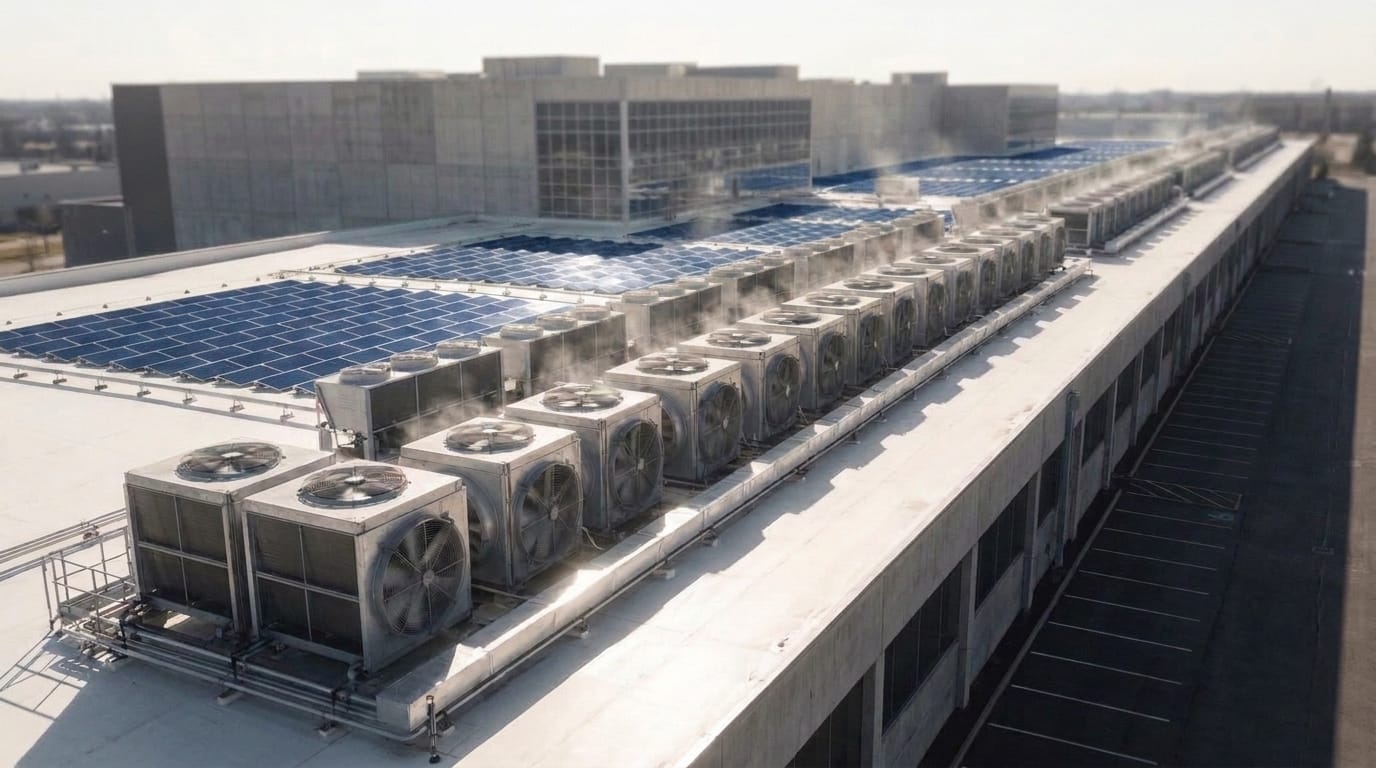
The conversation about data center efficiency almost always happens indoors. Rack density, airflow, liquid cooling loops, chip design. Those all matter, and they get the engineering attention. But the single largest sun-facing surface on the building rarely gets a seat at the table, and it is quietly shaping the cooling bill every afternoon.
That surface is the roof. For teams chasing a lower Power Usage Effectiveness number, it may be the most overlooked lever they have, and one of the least disruptive to pull.
The rooftop is the overlooked side of the cooling equation
Cooling can account for up to 40 percent of a data center's total energy use. Most of the effort to bring that number down looks inward, at how heat is moved once it is already inside the hall.
There is a cheaper place to act: keep the heat from entering in the first place. A dark low-slope membrane behaves like a thermal sponge, absorbing solar load through the day and driving it down into the structure, where the cooling system has to fight it hour after hour. The U.S. EPA covers this rooftop heat dynamic in its guidance on cool roofs, and the physics is the same whether the building holds servers or inventory.
Reflection helps, but heat rejection is what lasts
The common answer is a reflective coating, and reflectance does help. The catch is that reflectance is a surface property, and surfaces get dirty. Dust, pollen, and grime settle in, and measured reflectance drops through the first two or three years of service, right when the facility assumed the benefit was locked in.
Heat rejection is a different mechanism. Instead of relying only on bouncing light off a clean surface, a heat-rejection barrier blocks thermal transfer through the coating itself. That distinction matters most on a real roof that no one is scrubbing every quarter, because it is the performance that survives the second and third summer that actually shows up on the cooling bill.
What the cooling math looks like
When the roof stops feeding heat into the building, the cooling system gets an easier job. Building-energy research puts the achievable cooling-load reduction from a high-performance cool roof at up to about 50 percent, depending on climate, roof area, and how the system is loaded.
The surface numbers are just as striking. A bright, high-solids coating can hold a roof up to roughly 30 degrees Celsius cooler than a dark membrane on a hot afternoon. That temperature gap is the difference between a roof that radiates heat into the plenum and one that does not.
Facility teams have reported roughly a 20 percent drop in cooling cost on buildings after a heat-managing coating went down. On a data center, where cooling is such a large share of the total, even a portion of that reduction shows up quickly on the meter, and reduced thermal stress on chillers and compressors can defer the capital cost of replacing them.
Aligning the roof with on-site solar
More data centers are adding rooftop and on-site solar, and that creates a scheduling problem most teams do not plan for. Solar arrays are designed to last around 25 to 30 years, while a standard commercial roof often needs replacement or major repair every 7 to 10 years.
When the roof gives out first, the array has to come off and go back on, at real cost and real downtime. A durable, fluid-applied coating that restores the existing roof helps close that gap, so the roof and the power system can function as one long-term asset instead of two mismatched ones.
Restore instead of replace
Downtime is the ultimate cost in this industry, which makes a full roof tear-off a genuinely disruptive event. Dust and vibration are exactly what sensitive equipment does not want anywhere near it.
A fluid-applied coating avoids most of that. It goes over the existing roof, fills seams and small cracks into a monolithic surface, and lets the facility stay in service while the work happens. It also keeps tons of old roofing material out of a landfill, which trims disposal cost along the way.
Specify for the number that still holds in year three
Cool-roof requirements are moving into energy codes, and more of them now call for aged reflectance and Solar Reflectance Index minimums rather than just a new-roof rating. That shift rewards coatings that hold their performance as the roof weathers, and it puts a premium on the material under the label.
This is where the chemistry starts to matter. NanoTech's Cool Roof Coat is built on patented Insulative Ceramic Particle technology, an engineered hollow ceramic structure that blocks thermal transfer at the particle level, so the barrier keeps working as the surface ages and collects dirt. It bonds to TPO, EPDM, metal, and spray foam with no primer, which keeps installation on an occupied facility fast and low in disruption.
For data center and facility teams modeling their next efficiency move, the roof deserves a line in the analysis next to the mechanical upgrades. To see the SRI+ performance data or talk through a specification, start with the Cool Roof Coat page and reach out to the NanoTech Materials team.
Share this article
Ready to Transform Your Building's Performance?
Learn how NanoTech Materials' advanced coating solutions can help you achieve your energy efficiency and sustainability goals.
Get Started