

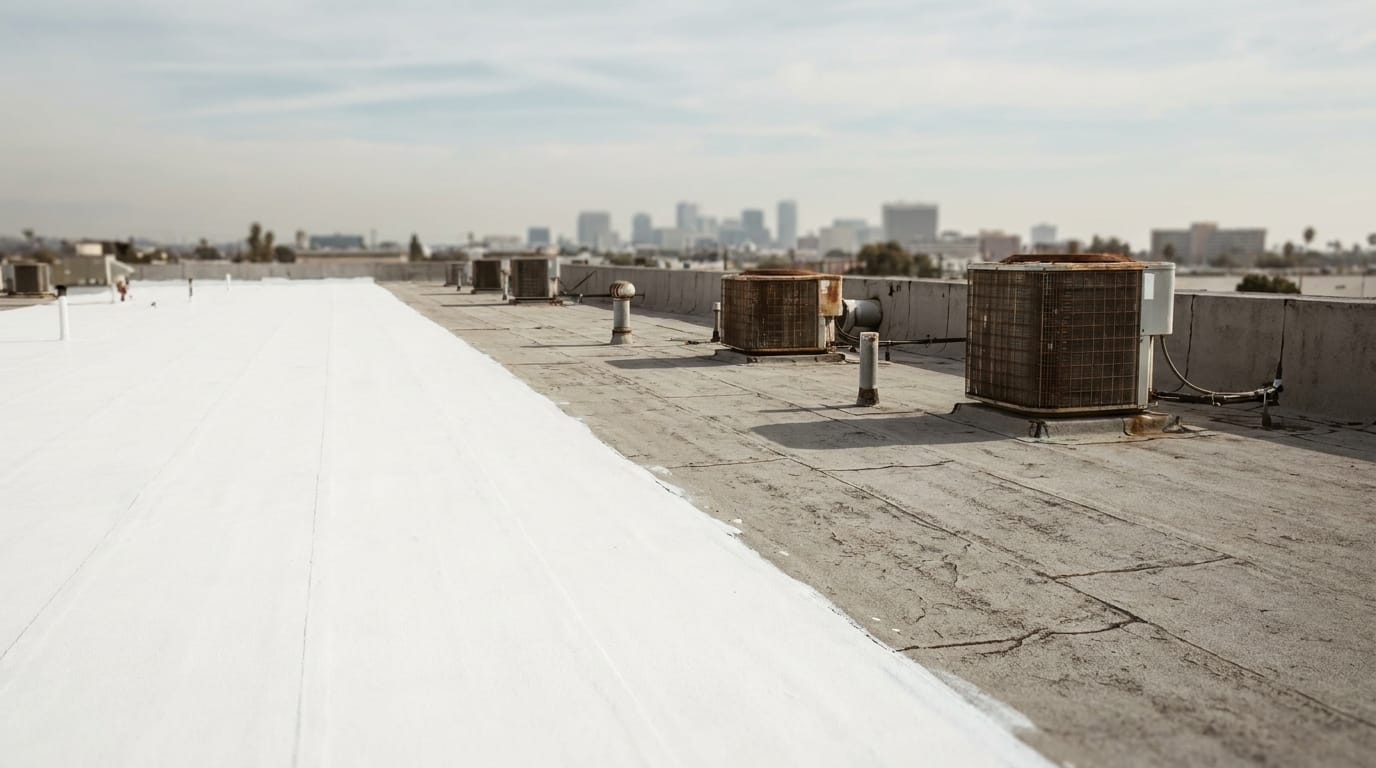
A commercial roof in a long cooling season does two jobs nobody specified for it. It keeps water out, and it collects solar energy all day and hands it to the mechanical system. On a warm-climate low-slope roof, surface temperatures run past 150°F, which loads the cooling equipment, raises energy use, and shortens the service life of the membrane underneath.
The coating that addresses that is well understood. What most building owners miss is that somebody else will help pay for it. Around 35 utility and municipal rebate programs across 11 states currently pay toward reflective roof coating, and a large share of eligible projects go through without anyone filing.
What the programs actually pay
Rebate structures vary, but the useful ones are priced per square foot, which makes the arithmetic quick on a commercial roof.
Austin Energy pays $0.25 per square foot specifically for reflective roof coating. Orlando Utilities Commission pays $0.12. The Los Angeles Department of Water and Power now offers rebates for qualifying cool roof installations, which matters because Los Angeles combines year-round solar exposure with a long cooling season and a pronounced urban heat island effect.
Run Austin's rate against a 100,000 square foot roof and the program contributes $25,000. That is not a rounding error on a restoration budget. It is the difference between a project that clears a capital committee this year and one that gets deferred to next year.
Separately, Section 179D lookback studies remain available on buildings already placed in service, even though the deduction closed to new construction after June 30, 2026. A lookback study is a different instrument from a utility rebate and the two are not mutually exclusive, so a tax advisor is worth a call before the scope is final.
The two rules that gate the money
Almost every program applies the same two conditions, and both are easy to fail by accident.
First, the product has to carry the rating the program names. In the United States that means a Cool Roof Rating Council listing. The ENERGY STAR roofing products specification was retired in June 2022, so any specification, submittal or marketing sheet still pointing at ENERGY STAR for roofing is citing a program that no longer exists. If a plan reviewer or a rebate administrator asks for a rating, they are asking for a CRRC Product ID.
Second, most programs require the application to be filed before work begins. A completed roof is usually ineligible retroactively. That single sequencing detail is the most common reason money is left on the table, because the rebate step sits with a facilities or finance team while the schedule sits with a contractor, and neither owns the handoff.
A third condition shows up in the more demanding jurisdictions: an aged performance threshold rather than an initial one. Atlanta ordinance 25-O-1310, in force since June 2026, requires a three-year aged solar reflectance of 0.70 and a Solar Reflectance Index of 85 on low-slope roofs. California Title 24 computes SRI per ASTM E1980-2019. A product can meet a day-one number and miss the aged number, and the aged number is the one written into these codes.
Chemistry selection is mostly a drainage decision
Cool roof coatings are commonly grouped into acrylic, silicone and elastomeric systems, and the practical difference between them on a specific roof is usually about water rather than about reflectance.
Acrylics are water-based and perform well in high-ultraviolet, drier climate zones, but prolonged ponding degrades them. Silicones tolerate standing water better, which makes them the default answer on roofs with poor slope or a drainage history. Elastomerics build a thicker, more flexible film that accommodates movement on older decks.
This is why a moisture survey belongs ahead of a coating decision rather than after it. A roof with a drainage problem and a coating chosen for a dry roof will underperform in year three, and a rebate paid in year one does not change that.
Heat rejection is not the same measurement as heat reflection
Rebate programs and codes are written around solar reflectance and thermal emittance, because those are the properties a rating body can measure repeatably. Those properties describe how much radiation a surface sends back and how readily it sheds the heat it holds.
They do not fully describe what happens to the energy a reflective surface still absorbs and conducts into the assembly. That transfer is a separate mechanism, and it is the one that determines how much load actually arrives at the cooling equipment. NanoTech's Insulative Ceramic Particle platform addresses that transfer by distributing a thermal barrier through the film rather than relying on a surface property alone, which is also why the behavior persists as the surface soils and weathers.
For a rebate application, cite the CRRC listing, because that is what the program will verify. For a performance decision, ask both questions, because the rating and the load reduction are not the same measurement.
A practical sequence, and where to start
Confirm which utility and municipal programs cover the building's jurisdiction, and note each program's filing deadline relative to notice to proceed. Pull the aged reflectance and SRI thresholds that apply to the roof's slope class. Order a moisture survey before selecting chemistry. Verify the product's CRRC Product ID and, where the jurisdiction requires it, its Title 24 compliance documentation. File the rebate application before mobilization, not after substantial completion.
Every step there is administrative. None of it requires a change to the roof design. It is the cheapest money in a roofing budget and it goes unclaimed because it belongs to nobody in particular.
Cool Roof Coat documents its rating so a plan reviewer or rebate administrator can verify it directly. See the Cool Roof Coat product page for certifications and specification detail.
If the roof is a restoration candidate rather than a replacement, the economics and sequencing are covered on the roof restoration and energy efficiency application page.
Contractors and facility managers working across multiple jurisdictions may find the commercial and industrial roofing overview a faster starting point.
To verify a rating independently, search the Cool Roof Rating Council rated products directory.
Program terms and current per-square-foot rates are published by the utilities themselves, for example Austin Energy's commercial rebate program.
Talk to NanoTech about a Cool Roof Coat specification, a rebate-eligible scope, or a Certified Applicator in your region.
Share this article
Ready to Transform Your Building's Performance?
Learn how NanoTech Materials' advanced coating solutions can help you achieve your energy efficiency and sustainability goals.
Get Started