

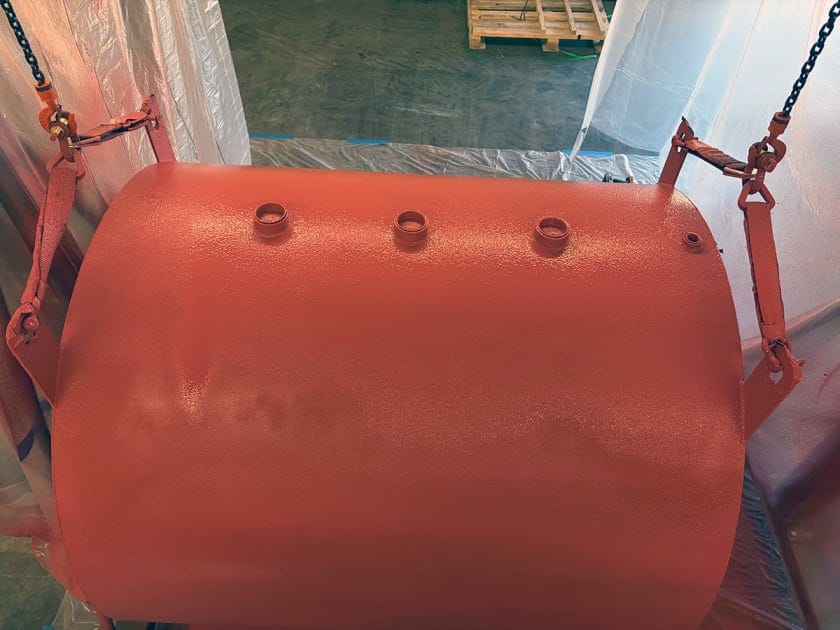
Last week we sprayed NanoTech Insulator onto a boiler feedwater tank and the piping that runs off it. The tank is 304 stainless steel. The coating is red, went on at about 55 mils wet, and was built to a 40 mil dry film.
Feedwater equipment runs hot for its whole working life, and the people who maintain a boiler room work within arm's reach of it. Slowing the heat that moves from the steel into the room does two jobs at once. The outer surface runs cooler for anyone who touches it, and the tank keeps more of the heat it is supposed to be holding.
Project at a glance
Equipment | Boiler feedwater tank and adjacent piping |
Substrate | 304 stainless steel, exterior |
Coating | NanoTech Insulator, from the Insulative Coating System |
Film build | About 55 mils wet, targeting 40 mils dry |
Primary goal | Lower exterior surface temperature and reduce the risk of contact burns |
Secondary benefit | Less heat lost from the tank between cycles |
The problem with hot equipment people work beside
A feedwater tank holds water on its way into the boiler, and it's kept hot so the boiler isn't starting from cold every cycle. That heat doesn't stay put. Bare metal passes it straight through to the outer skin, where it turns into two problems: a surface hot enough to burn someone who leans on it or grabs a fitting, and a steady loss of energy the plant has already paid for.
The usual answer is mineral wool or fiberglass with a metal jacket over it. It works. It also adds bulk around nozzles and fittings, has to come off for every inspection, and once water gets past the jacket it can sit against the steel for years before anyone sees it.
The application
NanoTech Insulator went on by spray at roughly 55 mils wet film thickness, targeting 40 mils dry.
The 40 mil target comes straight from the technical data sheet, which lists 40 mils dry as the minimum film for personnel protection testing under NACE TM21423. Our published ratings put NanoTech Insulator at personnel protection on surfaces up to 220°F in one pass and 350°F in two, tested to that same standard. So the right build for any asset depends on how hot it runs.
The coating is water-based with no reportable VOCs, and it sprays on rather than being cut, wrapped and banded.
How a thin film slows heat down
The working ingredient is our Patented Insulative Ceramic Particle, the same technology behind every NanoTech Materials coating. The particle is distributed through the whole film instead of sitting on its surface, so the cured coating itself has very low thermal conductivity. Heat leaving the hot steel has to work its way through that layer before it reaches the air, and the outer surface ends up cooler than bare metal would be.
The same layer that cools the outside slows heat leaving the inside. For a tank that cycles, more of its heat is still there when the next cycle starts.
And because the coating bonds directly to the steel, there's no jacket and no gap where water can collect. That gap is how traditional insulation sets up corrosion under insulation.
What we'll measure next
We don't have in-service numbers from this tank yet. The coating went on last week, and the tank hasn't been back in operation. Once it is, we'll take surface temperature readings on the coated shell and piping and post them here next to the operating temperature, so the result can be judged against the conditions the tank actually runs in.
Thanks to the crew for a clean application and for documenting it.
Talk to us about hot equipment
If you're weighing insulation options for tanks, vessels or piping that people work around, our team can walk you through the Insulative Coating System (NanoTech Zinc Primer, NanoTech Insulator and NanoTech Insulator TopCoat) and help size a film build to your operating temperatures.
Share this article
Ready to Transform Your Building's Performance?
Learn how NanoTech Materials' advanced coating solutions can help you achieve your energy efficiency and sustainability goals.
Get Started