

Industry
Wildfire Defense for Transportation Infrastructure
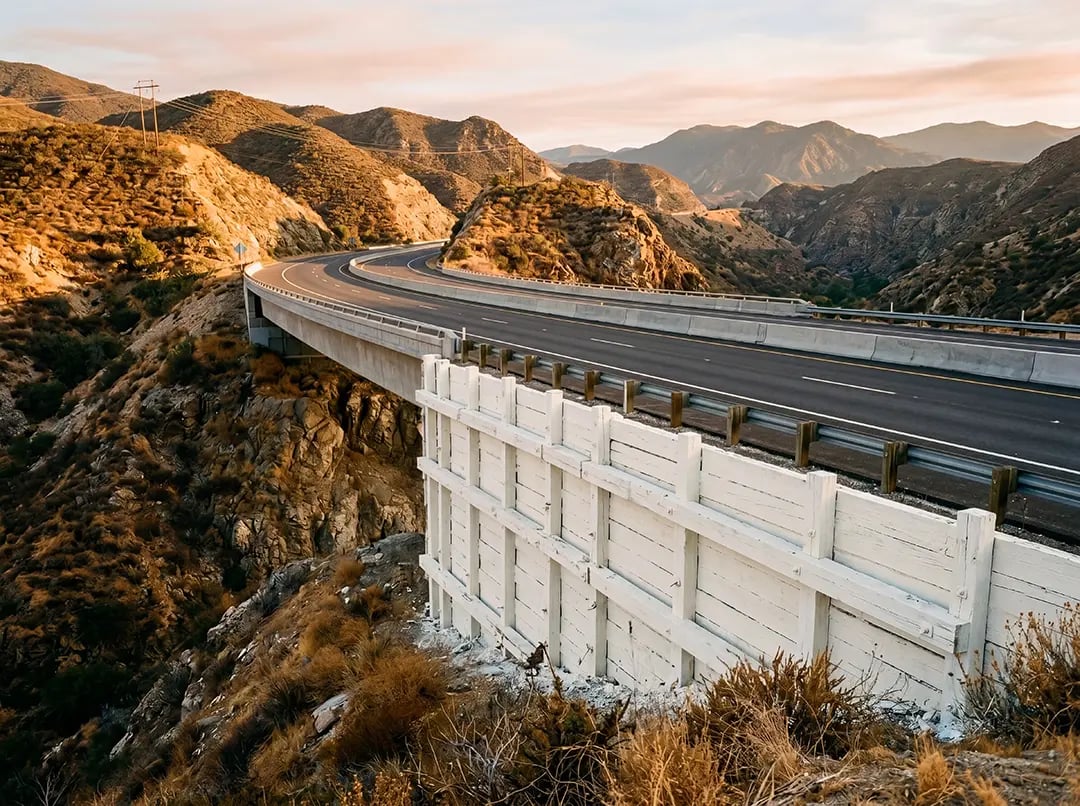
Highway bridges, slope stabilization systems, and public works rely on miles of timber that's largely unprotected against wildfire. Wildfire Shield extends timber lifespan and keeps evacuation routes and freight corridors operational through fire events.
The Challenge
Timber transportation infrastructure is a growing wildfire liability
DOTs and transit authorities operate vast inventories of timber lagging, bridge framing, retaining walls, and signage substrates across fire-prone corridors. Most of it is unprotected — and most of it can't be quickly replaced after a fire.
When wildfire damages a highway overpass or a timber retaining wall, the closures last months. Power, water, and transit corridors go offline at exactly the moment they're most needed, and remediation costs scale with the months of detour.
Asset owners need a way to harden the timber components they already have — without rebuilding the structure in steel or concrete, and without taking the corridor offline for the upgrade itself.
The Solution
Protect the timber. Keep the corridor open.
Wildfire Shield is built on NanoTech's patented Insulative Ceramic Particle platform, the technology TIME named one of the Best Inventions of 2024. Applied to timber lagging, bridge framing, and slope stabilization assemblies, the coating slows heat transfer into the substrate and raises the effective ignition threshold under flame impingement and radiant heat, keeping critical transportation infrastructure standing through fire events.
It bonds with creosote- and CCA-treated timber, plus legacy pentachlorophenol-treated lumber still in service across DOT and rail networks. Application can typically occur with minimal traffic disruption, and the underlying structure remains protected across multiple fire events when the coating system is maintained, with inspection and recoating after direct flame contact, making it a long-term capital investment rather than a recurring maintenance line item.
Why DOTs and transit authorities specify Wildfire Shield
Keeps corridors operational
Reduces fire-driven closures on evacuation routes and freight corridors.
Multi-event protection
Protects the underlying structure across multiple fire events when the coating system is maintained; coating sections exposed to direct flame are inspected and reapplied after each significant event.
Non-toxic & ROW safe
Non-toxic with no hazardous off-gassing or runoff after cure; suitable for use in riparian zones, wetlands, and protected lands per project-specific environmental review.
Worth pricing against rebuilding
Coats timber already in service, an option worth pricing against rebuilding in steel or concrete.
Spec-ready documentation
Project-level specifications, application guides, and substrate guidance for procurement and review.
TIME Best Invention
Built on the patented Insulative Ceramic Particle platform recognized by TIME Magazine.
Transportation infrastructure scenarios
Timber lagging slope stabilization
Soldier-pile-and-lagging walls supporting cuts and embankments along DOT routes.
Highway overpass timber components
Treated wood beams, decking, and approach structures in fire-prone corridors.
Rural & forest road bridges
Wooden bridge framing, decking, and abutments on access roads through fire-prone landscapes.
Pedestrian & equestrian bridges
Wooden public bridges in trail systems and parks adjacent to highway right-of-way.
Erosion control & retaining systems
Timber retaining walls and erosion control structures along slopes and culverts.
Timber signage substrates
Wooden support structures for signage, gantries, and roadside features.
Built for DOT and transit authority specs
ASTM E84
Fire Testing
Non-Toxic
Toxicity
Treated Timber
Substrate
TIME Best Inventions 2024
Recognition
Brush · Spray · Roll
Application
Made in the USA
Origin
Wildfire Shield is suited for state DOTs, transit authorities, county public works departments, and bridge owners across fire-prone regions, including deployment on state department-of-transportation timber lagging assemblies. NanoTech provides project-specific technical documentation, application guides, and substrate guidance to support spec packages and RFP submissions.
Transportation infrastructure FAQs
Can Wildfire Shield be applied to creosote-treated timber lagging in DOT corridors?
Yes. Wildfire Shield is compatible with treated timber assemblies common in DOT and rail infrastructure, including creosote- and CCA-treated timber, as well as legacy pentachlorophenol-treated lumber still in service (penta wood-preservative registrations were cancelled by EPA in 2022, but in-service inventory remains substantial). Surface preparation requirements depend on substrate condition and are confirmed during project assessment.
Will the coating change the structural performance of timber bridges?
No. Wildfire Shield is a surface-applied protective coating that does not alter the structural properties of treated wood. It is designed to extend the service life of timber assets without modifying their structural performance.
Can Wildfire Shield be applied while a corridor stays open to traffic?
Application can typically occur with minimal disruption to traffic using brush, roller, or low-volume spray methods. Project teams coordinate lane closures and traffic management with the asset owner during planning.
Is the coating safe for use along watercourses and protected lands?
Yes. Wildfire Shield is non-toxic with no hazardous off-gassing or runoff after cure, making it suitable for riparian zones, wetlands, and protected lands traversed by transportation infrastructure, subject to project-specific environmental review.
Does Wildfire Shield support DOT and transit RFP specifications?
Yes. NanoTech provides project-specific technical documentation, application guidelines, and substrate guidance suitable for inclusion in DOT, transit authority, and bridge owner RFP packages.
How does Wildfire Shield compare to intumescent paint for transportation infrastructure?
Most intumescent products consume themselves during first ignition and require full reapplication after a single fire event. Wildfire Shield's underlying substrate stays protected across multiple fire events when the coating system is maintained, with inspection and reapplication of any coating areas exposed to high-heat direct flame. That makes it well-suited to transportation assets expected to face fire more than once across decades-long service lives.