

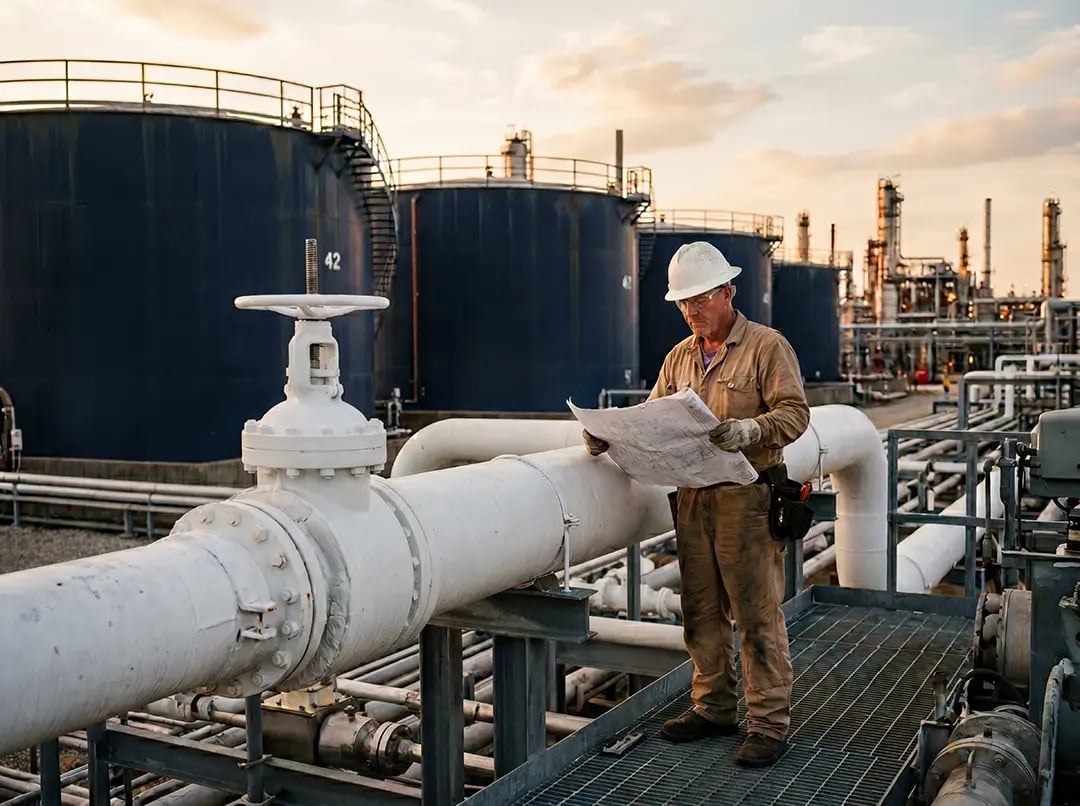
Industry
Industrial Insulative Coatings for Oil & Gas Facilities
Pipelines, tanks, vessels, and process equipment lose thermal energy and breed corrosion under insulation every day. Cool Touch is a thin-film insulative coating engineered for upstream, midstream, and downstream operations — retaining heat, preventing CUI, and bringing surface temperatures into safe-touch range.
The Challenge
Jacketed insulation is leaking energy and breeding corrosion
Oil and gas operations rely on miles of process piping, hundreds of vessels, and acres of equipment. Each one loses thermal energy continuously, drives up safety risk on uninsulated hot surfaces, and — when wrapped in traditional jacketed insulation — creates ideal conditions for corrosion under insulation (CUI).
CUI is one of the most expensive failure modes in upstream and downstream operations. Mineral wool jacketing hides the substrate, traps moisture against carbon steel, and creates a reliability problem that's typically diagnosed only after something fails.
Reliability, EHS, and process engineers need a thermal protection system that retains heat, eliminates CUI, and brings hot surfaces into safe-touch range — without the bulk, weight, and inspection burden of jacketing.
The Solution
Thin-film insulation engineered for industrial reliability
Cool Touch is part of the Insulative Ceramic Particle family: patented insulative ceramic particles dispersed in an industrial coating, the same platform behind Cool Roof Coat and Wildfire Shield. Applied in 1–2 coats, it bonds directly to pipes, tanks, vessels, and equipment, retaining process heat at the surface while bringing exposed hot surfaces toward the ≤140 °F (60 °C) contact-burn threshold defined by ASTM C1055.
Because the coating bonds to the substrate rather than wrapping around it, it eliminates the moisture trap that creates CUI in jacketed systems. The protected surface stays visible and inspectable — addressing both the safety hazard and the underlying corrosion mechanism.
Why O&G reliability and EHS teams choose Cool Touch
Stops corrosion under insulation
Bonds to substrate — no jacketing, no moisture trap, no hidden CUI.
Drops surface to safe-touch
1–2 coats bring hot pipes and equipment into OSHA-aligned safe-to-touch range.
Retains process heat
Thin-film insulative barrier slows heat loss at the substrate.
Inspectable surface
Coated equipment stays visible for routine reliability inspection.
1–2 coats, no bulk
Reduces support load, eases access for maintenance, simplifies turnaround scheduling.
Replaces failing jacketing
Strip out aging mineral wool and replace with a coating that doesn't fail the same way.
Oil & gas facility scenarios
Process piping & manifolds
Reduce energy loss across distribution networks while bringing surfaces into safe-touch range.
Storage tanks & vessels
Maintain process temperatures with less reliance on bulk jacketed insulation.
Heat exchangers & reboilers
Cut radiant heat losses on equipment that operates around the clock.
Distillation & refining columns
Stabilize column temperatures and reduce reboiler loads.
Compressor & pump skids
Hot surfaces on skid-mounted equipment, mobile compressors, and modular processing units.
Replacement of failed jacketing
Pull off mineral wool and silver, address underlying corrosion, recoat with Cool Touch.
Engineered for industrial reliability
1–2
Coats Required
Safe to Touch
Outcome
CUI Risk
Eliminates
TIME Best Inventions 2024
Recognition
Visible Substrate
Inspectability
Made in the USA
Origin
Cool Touch is part of NanoTech's TIME Best Invention-recognized Insulative Ceramic Particle platform. Project teams in upstream, midstream, and downstream operations receive substrate-specific application guidance, technical documentation, and reliability data to support specification, procurement, and turnaround planning.
Oil & gas industrial coating FAQs
Does Cool Touch eliminate corrosion under insulation (CUI)?
Yes. Because Cool Touch bonds directly to the substrate instead of wrapping it, it eliminates the moisture trap that creates CUI in traditional jacketed insulation systems. The substrate stays visible and inspectable — addressing both the safety hazard and the underlying corrosion mechanism.
How thick is Cool Touch compared to jacketed mineral wool?
Cool Touch is applied in just 1–2 coats and forms a thin-film insulative barrier at the substrate. The resulting profile is dramatically thinner than traditional jacketed mineral wool — reducing weight on supports and simplifying access for inspection and maintenance.
Does Cool Touch meet OSHA requirements for hot surface temperature?
Cool Touch is engineered to bring exposed hot surfaces to ≤140 °F (60 °C) per ASTM C1055 — the industry guide for heated system surface conditions that produce contact-burn injuries, and the standard OSHA's general duty clause references in practice. Final surface temperature depends on substrate temperature, ambient conditions, and coats applied — all confirmed during the project assessment.
Can Cool Touch be applied during scheduled turnarounds?
Yes. Most Cool Touch installations occur during scheduled turnarounds when systems are offline, which simplifies surface preparation and application. Application to in-service equipment is feasible in some cases — coordination depends on substrate temperature, accessibility, and safety constraints.
Is Cool Touch compatible with stainless steel, carbon steel, and aluminum?
Cool Touch is formulated to bond with the metallic substrates common in oil & gas process equipment. Compatibility for specific alloys and surface conditions is confirmed during the substrate evaluation and application planning phase.
Can Cool Touch replace failing jacketed insulation across an entire facility?
Yes. Plants strip out aged mineral wool and metal jacketing, address any underlying corrosion, and recoat with Cool Touch — turning a recurring CUI problem into a long-term reliability solution. Our team supports facility-scale planning and turnaround coordination.