

Application
Condensation Control & Freeze Protection for Cold & Cyclic Equipment
Cold equipment surfaces — chilled lines, outdoor valves, gas regulating equipment, anything that runs below ambient — collect condensation and, in freezing climates, ice. Cool Touch is a thin-film insulative coating that stabilizes surface temperature above the dew point, suppressing condensation at the source instead of fighting it with covers and heat tracing.
The Challenge
Covers and heat tracing fight the cold. They don't fix the surface.
Condensation forms whenever a metal surface drops below the dew point of the surrounding air — chilled-water piping, cryogenic-adjacent service, HVAC and refrigeration lines, and gas equipment cooled internally by pressure drop (the Joule–Thomson effect: roughly a 6–8°F drop for every 100 psi a gas regulator or valve sheds). In freezing climates, that condensate doesn't just drip — it accretes as ice on valves, linkages, and instrument ports.
The standard responses are protective covers and electric heat tracing. Both treat the symptom rather than the cause: heat tracing adds continuous energy draw, wiring, and points of failure, while covers can trap moisture against the metal. Neither changes the underlying surface-temperature behavior, so as soon as conditions shift, condensation and icing come back.
The same persistent surface wetness that causes icing also drives corrosion — and where insulation or covers trap that moisture against the metal, it accelerates corrosion under insulation (CUI). Condensation control and CUI prevention are two faces of the same heat-transfer problem.
The Solution
A thin-film barrier that keeps the surface above the dew point
Cool Touch decouples the outer surface from the cold substrate beneath it. By reducing heat flux through the metal and stabilizing temperature across it, the coating keeps the exterior surface closer to ambient air temperature — above the dew point under most operating conditions. With the surface no longer running below the dew point, condensation has little chance to form, and ice has nothing to build on.
It's the same physics NanoTech uses on hot service, running in the opposite direction: a thermal barrier reduces heat flux either way. On a hot pipe, it keeps the touchable surface cool. On cold gas equipment, chilled lines, or refrigeration piping, it keeps the surface warm relative to the chilled substrate. For cold-service and anti-condensation duty, Cool Touch is typically built up in multiple passes to 1–5 mm (40–200 mils) DFT, conforming to valve bodies, fittings, and instrument runs that are difficult to wrap with conventional insulation.
Why operations and reliability teams choose Cool Touch
Suppresses condensation at the source
Raises surface temperature above the dew point instead of fighting moisture after it forms.
Stops ice accumulation
Eliminates the surface-temperature conditions that let ice accrete on valves and instrumentation.
Reduces heat-trace dependence
Passive thermal stabilization lowers reliance on electric heat tracing and its energy draw and maintenance.
Doesn't create CUI risk
Seamless, adhered film — no jacket or wrap to trap moisture against the substrate.
Conforms to complex geometry
Spray, hopper, roller, or brush application follows valve bodies, fittings, and instrument ports.
Field-proven
Three consecutive winters of stable, ice-free field performance on outdoor gas equipment in Michigan.
Where condensation control and freeze protection apply
Natural gas meters, valves & regulator stations
Joule–Thomson cooling from pressure drop chills equipment from the inside; humid outdoor air does the rest.
Chilled water piping
Classic anti-sweat application — keep insulated lines from dripping onto floors, ceilings, and equipment below.
HVAC & refrigeration lines
Suction lines and cold equipment that run below ambient dew point year-round.
Outdoor instrumentation in freeze climates
Gauges, linkages, and instrument ports that ice over and become unreadable or inoperable.
Cryogenic-adjacent service
Equipment operating near (not at) cryogenic temperatures where condensation and icing are persistent.
Marine & offshore cold service
Salt-air environments where condensation control and corrosion resistance both matter.
Engineered for cold-service reliability
3 winters
Field-Proven Performance
1–5 mm
Cold-Service DFT (40–200 mils)
480 hrs
Condensation Tested (ISO 6270-1)
720 hrs
Salt Spray Tested (ISO 9227)
Reduced
Heat-Trace Dependence
Made in the USA
Origin
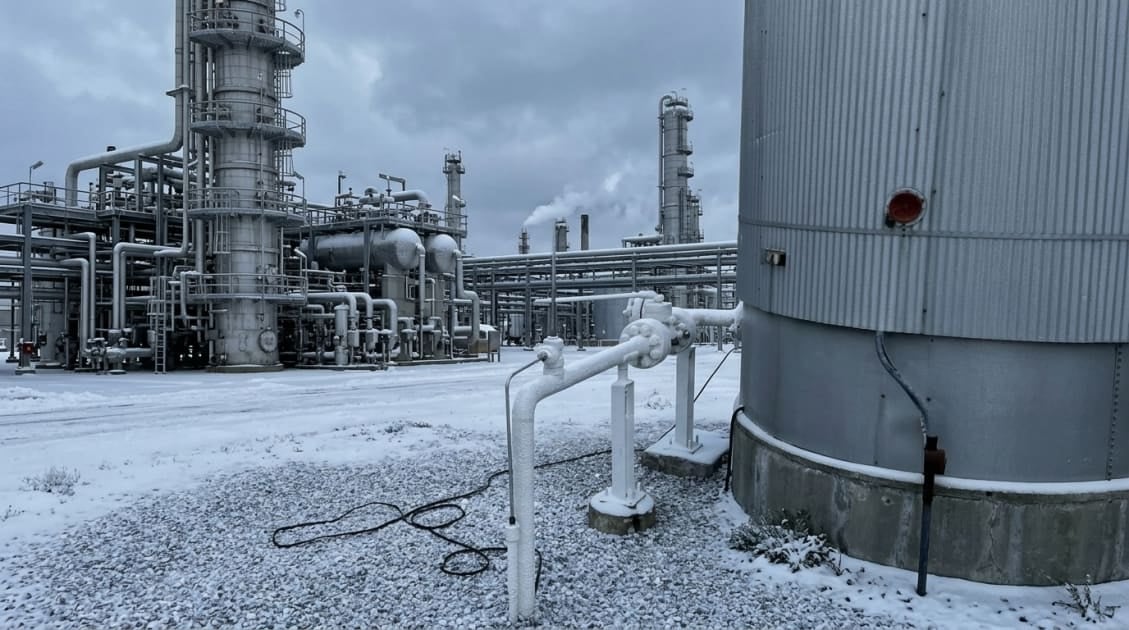
Cool Touch's condensation-suppression performance is field-documented, not just lab-tested: a Michigan natural gas operator applied a 5 mm coating build to outdoor valves, meters, and piping and eliminated major ice accumulation across three consecutive winters in a lake-effect snowbelt.
Condensation & freeze protection FAQs
How does a coating stop condensation and ice from forming?
Condensation and ice form when a surface sits below the dew point of the surrounding air (and, for ice, below freezing). Cool Touch adds thermal resistance between the cold substrate and the outer surface, reducing heat flux and stabilizing the surface temperature closer to ambient. Keeping the exterior surface above the dew point under most conditions suppresses condensation, so ice has nothing to accrete on.
Why does equipment like gas valves and meters ice up in the first place?
Two effects combine. Gas expanding across a regulator or valve cools through the Joule–Thomson effect — roughly 6–8°F per 100 psi of pressure drop — chilling the metal from the inside. Outside, cold humid air contacts that chilled metal. When the surface sits below the dew point and below 32°F, moisture condenses and freezes on valves and instrumentation. The same mechanism applies to chilled-water and refrigeration lines without the freezing step.
Can Cool Touch replace electric heat tracing entirely?
In documented field use, Cool Touch reduced dependence on heat tracing rather than eliminating every circuit. By passively stabilizing surface temperature, it addresses the heat-transfer behavior that causes icing, lowering the load on active heating. Whether tracing can be fully removed depends on the specific service, fluid temperature, and pressure drops involved — confirmed during project assessment.
Does condensation-control duty create the same CUI risk as wrapped insulation?
No. Cool Touch is a seamless, adhered film rather than a jacketed or wrapped system, so it doesn't create the gaps where water collects against the metal. It's tested for both condensation resistance (ISO 6270-1, 480 hours) and salt-spray/corrosion performance (ISO 9227, 720 hours), and is suitable for humid and salt-spray environments.
How thick does the coating need to be for cold-service vs. hot-side use?
Cold-service and anti-condensation duty is typically built up to 1–5 mm (40–200 mils) DFT in multiple passes, heavier than the 40–80 mil range used for hot-side personnel-protection duty. Required build depends on substrate temperature, ambient climate, and service conditions — confirmed per project.
Is the Michigan field result repeatable in other cold climates?
The underlying mechanism is general: anywhere humid air meets a sub-dew-point metal surface — northern winters, chilled-water systems, refrigerated and cryogenic-adjacent service — the same heat-flux and surface-temperature physics apply. Results at any given site depend on gas or fluid conditions, geometry, ambient climate, and the specified coating build, which NanoTech reviews per project.